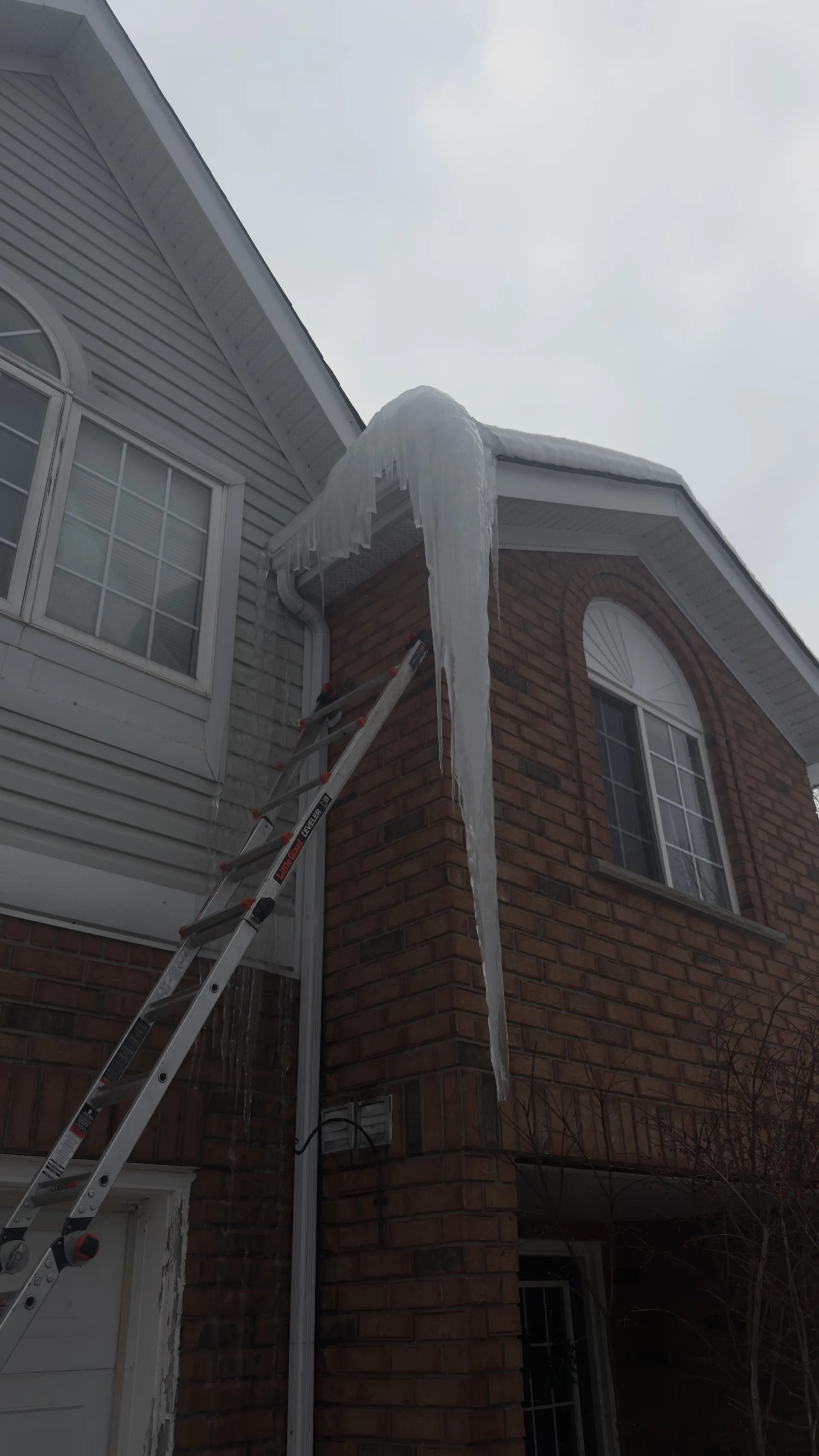
Ice-related water damage starts small and shows itself outside long before it reaches a ceiling, and a short walk at the right moments catches it. This guide follows the water from the roof edge to the foundation, shows when to look and rates each finding by urgency.
In This Article
Follow the water: six stops from eave to foundation
- The eave. From the ground, with binoculars, look along the roof edge. Small, evenly spaced icicles are ordinary. A thick ridge of ice, or big clusters in one spot, point to trouble above.
- The trough. Look for sags, bulges and any place where the run has pulled away from the fascia. Ice adds weight, so a run that looked straight in November may bow now.
- The outlets. Check where each trough meets a downspout. Ice hanging from the outlet, or a curtain of ice spilling over the front edge nearby, means water is not getting in.
- The downspouts. Look for bulges and splits, which frozen water can cause, and for drip stains at the joints.
- The discharge. Confirm that each outlet still points away from walks, steps and the foundation, and that a snowbank has not blocked it.
- The foundation and the walls. Look for ice or damp patches along the base of the wall, and for stains on the siding or soffit below the eave.
Pick your moments
- After the first hard freeze. Photograph each side of the house as a baseline.
- On a mild afternoon during a thaw. Water moves, so you can watch where it goes and what is blocked. This is the most useful walk of the winter.
- After a heavy snowfall or a deep cold snap. Check for load and new blockages.
- In late winter, before the big melt. Look again at the outlets and discharge, since the spring runoff will use them.
Freeze-thaw cycles are common from November to April, so any of these days can bring the conditions you are looking for.
Want your driveway cleared before 7am?
Seasonal snow removal for homes across Kitchener, Waterloo, Cambridge & Guelph, so winter mornings take care of themselves. Free, no-obligation quotes, ready within 1 business day.
Reading what you find
| What you see | How urgent | What to do |
|---|---|---|
| Small, even icicles | Low | Normal. Keep people out from under them |
| Large icicle clusters in one spot | Medium | Photograph them and look for the cause. Have a crew check once it is safe |
| An ice curtain spilling over a trough | Medium to high | Water is not reaching the downspout. Clear snow from its foot, and book a clean for the first thaw |
| A sagging or bowed trough loaded with ice | High | Keep people away, and call a professional |
| A ridge of ice at the eave, plus stains indoors | Urgent | A possible ice dam leak. Protect belongings, photograph the damage, and call a roofer and your insurer |
| An ice sheet spreading across a walk or steps | Safety, now | Sand it, and redirect the outlet |
Where ice-related water shows up indoors
Not every leak drips. Look for:
- Brown or yellow stains on a ceiling along an exterior wall, often spreading after a thaw.
- Bubbling paint or a damp patch high on an exterior wall, where water has tracked behind the fascia, soffit or siding.
- Drips at the head of an upstairs window, or damp trim below it.
- A damp strip along one basement wall in early spring, which can mean melt is landing beside the foundation.
Trace the edge of a stain in pencil and write the date beside it. If the mark has grown after the next thaw, water is still getting in, and the walk outside will usually show where.
Keep the log short
One page is enough. For each walk, write the date, the weather and what you saw at each of the six stops, and note the name of the photo file. Shoot from the same spots each time so that changes stand out. A contractor who sees three photos of the same corner over six weeks knows more than one who hears "it looks bad".
What is yours to fix, and what is a crew's
Yours: clearing snow from the foot of a downspout, lifting a flip-up extension, sanding a slick patch and taking the photos. Do not chip ice, and do not climb a ladder onto ice.
A crew's: clearing plugged runs, reseating hangers, resealing joints, replacing bowed sections and anything at height. On the crew side, D&D Home Services starts gutter cleaning at $125 for a typical Kitchener-Waterloo home, and a damaged run that needs replacing is eavestrough installation work, priced by written quote.
For what damage looks like once the thaw arrives, see how to spot gutter damage, and for the roof side of the problem, the snow and ice damage prevention guide.
Key Takeaways
- Follow the water in order: eave, trough, outlets, downspouts, discharge, then the foundation and walls.
- Walk on a mild afternoon in a thaw, because moving water shows what is blocked, and repeat after big snowfalls and before the spring melt.
- Rate each finding by urgency, from ordinary small icicles to a sagging ice-loaded trough or a leak indoors.
- Keep a one-page log with photos from the same spots, and leave ladder work and ice chipping to a crew.

Request a home-service quote
Select the service you need and describe the work area and access.