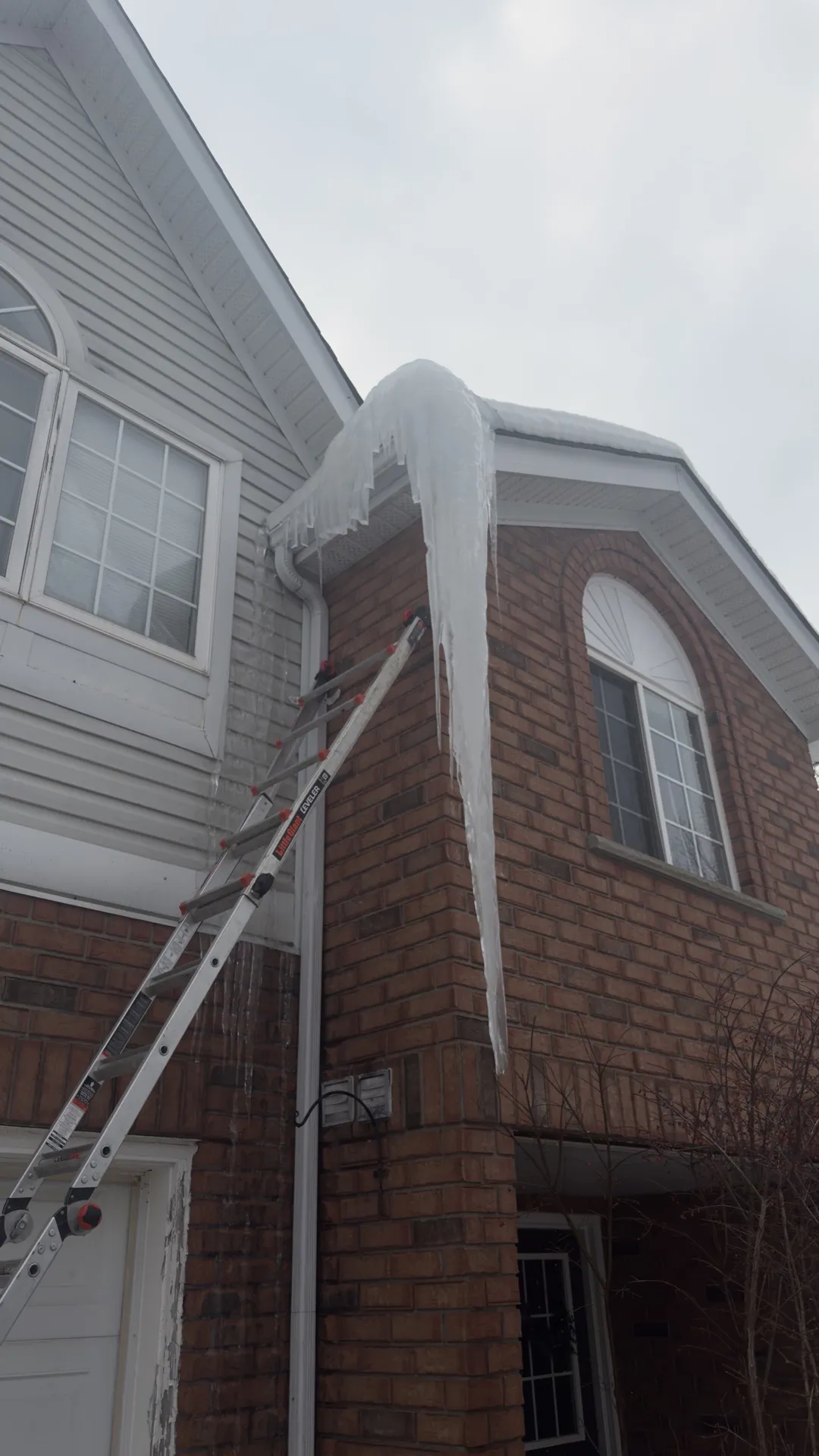
Southern Ontario winters bring unique challenges for homeowners. Ice dams, frozen eavestroughs, salt-corroded driveways, and siding damage from heavy snowfall are annual concerns in the Kitchener-Waterloo region. Here's how to prevent the most common and costly forms of winter exterior damage.
In This Article
Ice Dams: What They Are and Why They're Dangerous
Ice dams form when heat escapes from a warm attic, melts the lower layer of snow on the roof, and the meltwater runs down the slope and refreezes at the cold overhang (eave). As this cycle continues, ice builds up at the eave, the "dam", and liquid water backs up behind it under the shingles.
This backed-up water is the real problem. It works its way under shingles and into the roof deck, causing:
- Roof sheathing rot
- Insulation saturation (dramatically reducing thermal performance)
- Ceiling and wall staining
- Structural damage to rafters in severe cases
- Interior mold growth
Ice dams are most common on homes with: low-slope roofs, inadequate attic insulation, poor attic ventilation, or skylights and chimneys that create uneven heat distribution on the roof surface.

How to Prevent Ice Dam Formation
The root cause of ice dams is an unevenly heated roof, specifically, a warm attic above a cold eave. Address the root cause:
- Improve attic insulation: Target a minimum R-50 in attic floors, keeps heat in the living space, not the attic
- Improve attic ventilation: A properly ventilated attic maintains cold, uniform temperatures on the roof deck, preventing uneven melting
- Air seal attic penetrations: Recessed lights, plumbing vents, and attic hatches are common heat leakage points
- Install ice and water shield: A rubber membrane under shingles at the eave zone provides a waterproof barrier even if water backs up
- Heated cable systems: Electric heat cables installed in a zigzag pattern on the eave maintain a drainage channel, a treatment, not a cure
"Ice dams are a symptom of an insulation and ventilation problem, not just a roof problem. The fix starts in the attic, not on the roof."
- D&D Home Services, Kitchener-Waterloo
Need a hand with your home's exterior?
From gutters and windows to full exterior washes, we help homeowners across Kitchener, Waterloo, Cambridge & Guelph. Free, no-obligation quotes, ready within 1 business day.
Protecting Your Gutters Through Winter
Frozen gutters are a common winter problem in Ontario. When a gutter fills with snow and water that then freezes solid, the weight can pull the gutter off the fascia, sometimes taking fascia boards with it.
Prevention:
- Ensure gutters are clean before freeze-up, clogged gutters hold water that freezes and expands destructively
- Check that all hangers are secure and properly spaced (maximum 600mm apart)
- Consider installing gutter guards to prevent debris accumulation
- After major freeze events, do not chip ice from frozen gutters, let it thaw naturally. Ice removal attempts frequently cause gutter damage.
Safe Ice Removal for Driveways & Walkways
De-icing salt is highly effective but comes with costs:
- Sodium chloride (rock salt) is corrosive to concrete, asphalt, metal, and plant life
- It accelerates the freeze-thaw damage cycle in unsealed concrete and asphalt
- Salt runoff damages nearby lawn and garden areas
Choose for the surface:
- Calcium chloride: NRMCA lists calcium and sodium chloride as acceptable concrete de-icers when used moderately, while advising avoidance in the first winter. This is not a guarantee of no damage.
- Magnesium-based salts: NRMCA advises against their use as concrete de-icers because they can chemically attack the surface. Do not choose them for concrete on an assumed gentler-material claim.
- Sand: Provides traction without chemical damage, ideal for use after initial ice removal
- Mechanical removal: Snow blowing and shoveling before surfaces freeze reduce the need for chemical de-icers
For concrete, NRMCA recommends a breathable sealer or water repellent designed for the slab and applied as its manufacturer directs. Sealing does not make every de-icer suitable or eliminate scaling risk. Avoid de-icing chemicals in the first winter, use clean sand for traction, and use permitted de-icers moderately in later winters. Concrete guidance does not establish the treatment for asphalt or pavers.
Tip: Check the actual de-icer’s surface, temperature, timing and dose instructions before pretreatment. Do not use a general before-snowfall tip to override the concrete first-winter and product-compatibility limits above.
Siding & Window Protection in Winter
- Keep snow cleared away from the base of siding, prolonged contact with snow accelerates moisture infiltration and biological growth
- Do not assume an automotive ice scraper is suitable for a building window or its coating. Check the window maker’s instructions; Andersen warns against abrasive tools and metal blades on its products. Avoid forcing ice off the glass or frame.
- Inspect caulking around windows after severe temperature swings, caulk can crack and pull away in extreme cold
- Be careful with snow blower discharge direction, impacting siding repeatedly with packed snow can cause stress cracks in vinyl
Professional Snow Removal Services
D&D Home Services provides seasonal snow removal contracts in Kitchener, Waterloo, Cambridge, and Guelph. Our contracts include response time guarantees so you're never left trying to reach your vehicle after an overnight snowfall. Professional snow removal also means your driveway and walkways are cleared correctly, protecting sealed asphalt surfaces and preventing the ice buildup that leads to shoveling injuries.
Winter Emergency Checklist
When to Take Action
- If you see icicles hanging from a consistent line along your roofline → potential ice dam forming
- If you see water staining or peeling paint on your ceiling near exterior walls → ice dam water entry
- If gutters are pulling away from the fascia → frozen gutter weight, do not attempt to remove ice yourself
- If concrete is flaking or scaling, assess the cause before choosing a repair or sealer; freezing, saturation, concrete quality, finishing, curing and de-icers can contribute. Asphalt deterioration needs its own assessment. Sealing in fall is not a guaranteed fix.
- If large snow loads accumulate on low-slope sections → consider professional snow clearing for roof safety

Residential snow removal (from $80 per visit)
Tell us the driveway size and whether walkways need clearing too.