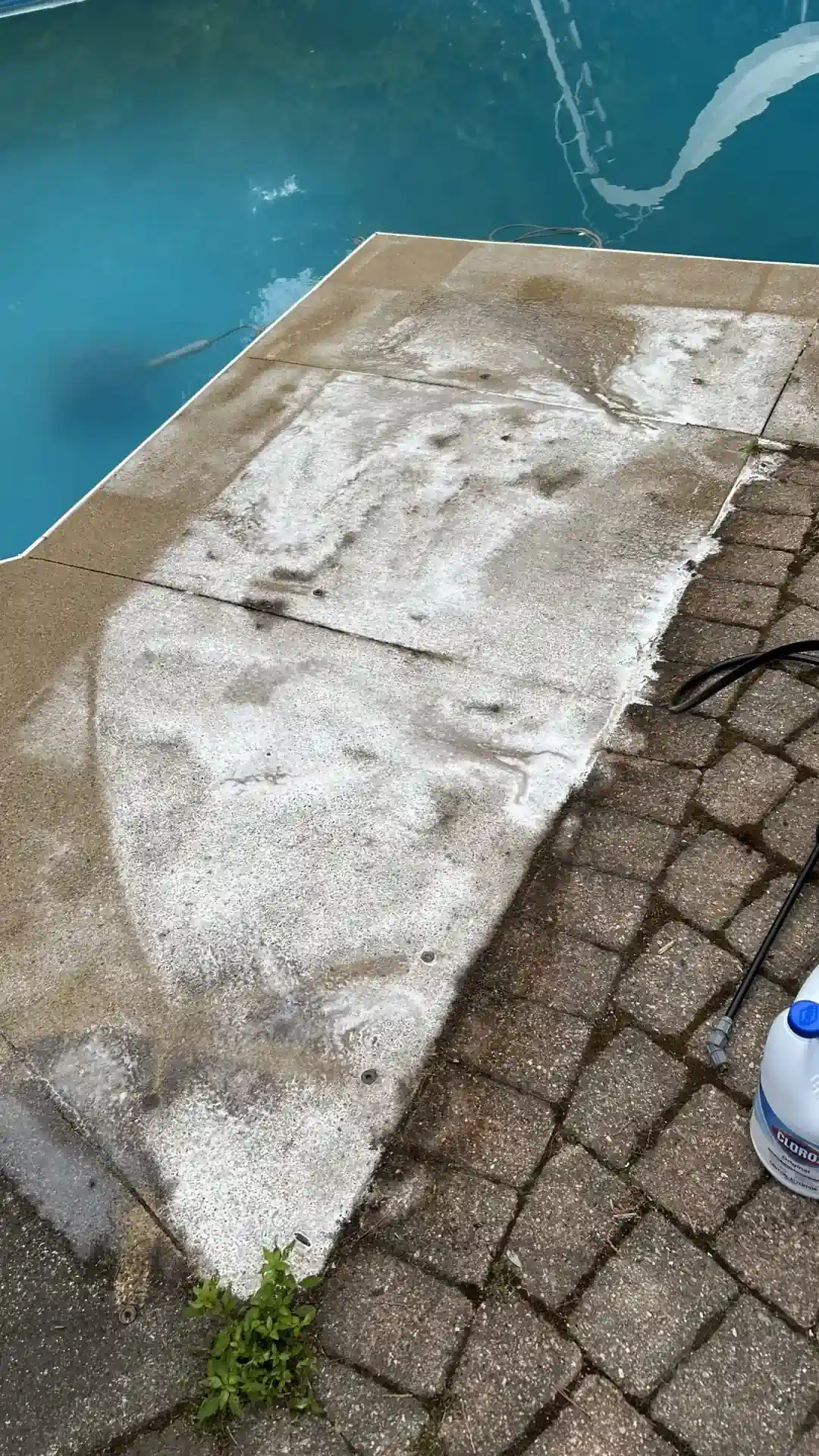
The internet will tell you that a bucket of bleach diluted with water and a soft brush will clean your siding just as well as a professional soft wash. Sometimes it's true, and sometimes it results in damaged plants, uneven cleaning, or siding that's clean for two weeks before the growth returns. Here's the actual difference.
In This Article
The DIY Bleach Approach
The standard DIY soft wash recommendation is: mix 1 part household bleach (sodium hypochlorite ~6%) with 3–4 parts water, add a squirt of dish soap, apply with a garden sprayer or soft brush, let dwell 10 minutes, rinse.
This does work, to a degree. Household bleach will kill algae, mold, and mildew on contact. For small areas, accessible surfaces, and homeowners who are comfortable with the process, this can produce satisfactory results.
Where it typically falls short:
- Inconsistent dilution, household bleach concentration varies (typically 6-8.25%); without precise measurement, concentration is unpredictable
- Limited volume, a garden sprayer delivers much lower volume than a professional system, making large areas impractical and often unevenly cleaned
- Dwell time control, on hot days, DIY solutions evaporate before fully killing biological growth, leading to faster regrowth
- Landscape protection, applying significant bleach solution near foundation plantings without proper pre-wetting and post-rinsing frequently damages plants

What Professional Soft Washing Adds
Beyond the basic bleach-plus-surfactant formula, professional soft washing adds:
- Precisely calibrated concentration: Commercial sodium hypochlorite (12.5%) is diluted on-site to the specific percentage appropriate for each surface, typically 1–3% for residential siding
- Professional-grade surfactants: Commercial surfactants are significantly more effective than dish soap at helping solution adhere to vertical surfaces and penetrate biological growth
- High-volume delivery: Professional systems deliver consistent coverage at rates DIY equipment can't match, ensuring full surface saturation for uniform results
- Controlled rinse: Low-pressure rinse that thoroughly removes solution without pressure-washing risk
- Systematic pre and post-wetting of landscaping
Need a hand with your home's exterior?
From gutters and windows to full exterior washes, we help homeowners across Kitchener, Waterloo, Cambridge & Guelph. Free, no-obligation quotes, ready within 1 business day.
Concentration: Where DIY Most Often Goes Wrong
The two most common DIY concentration errors:
- Too weak: The solution doesn't fully kill the biological growth, it bleaches it white temporarily. Within weeks, the growth returns to its original appearance as surviving organisms repopulate. This is the most common DIY soft washing complaint.
- Too strong: Excessive concentration can cause siding discolouration (particularly on darker colours), damage rubber weatherstripping, and significantly increases plant damage risk
Professional technicians test and calibrate concentration for each surface and situation. This precision is difficult to achieve with household products.
"We see it regularly: homeowners who DIY cleaned their siding and are frustrated that the algae is back in six weeks. The solution was too dilute, it bleached the surface without killing the growth."
- D&D Home Services
The Equipment Difference
Professional soft washing equipment includes:
- A dedicated chemical mixing and delivery system with precise ratio controls
- High-volume low-pressure pump capable of covering a 2,000 sq ft home in a single fill
- Extension wands and specialized nozzles for uniform coverage at height without ladders
- Dedicated low-pressure rinse system separate from the chemical system
A garden sprayer filled with DIY bleach solution simply can't replicate the volume, consistency, and precision of professional equipment.
Protecting Your Landscaping
This is the area where DIY attempts most commonly cause unintended damage. Professional soft washers:
- Thoroughly pre-wet all plants, soil, and grass within the application area before starting
- Have dedicated rinse capacity to flush all plant surfaces immediately after application
- Know which plant species are more sensitive (hostas, azaleas, and impatiens, for example, are more susceptible than hardy shrubs)
DIY application often skips or shortcuts the pre-wetting step, and the garden sprayer used for application rarely has enough clean water capacity for a proper post-rinse.
When DIY Is a Reasonable Approach
- Small, accessible areas (a single wall or fence section)
- Homeowners with no significant landscaping to protect
- Single-story properties where application is easily controlled
- Maintenance touch-ups between professional cleans
Cost Comparison
DIY vs. Professional, Real Costs
- DIY materials (bleach, sprayer, surfactant): $30–$80 + 4–6 hours of time
- DIY risk: Landscape damage ($100–$500 in replacement plants), uneven results, faster regrowth
- Professional soft wash (average home): $300–$600, typically 2–3 hours
- Professional result duration: 2–4 years vs. 3–12 months for DIY
- Annualized cost comparison is often closer than it appears

Request a home-service quote
Select the service you need and describe the work area and access.