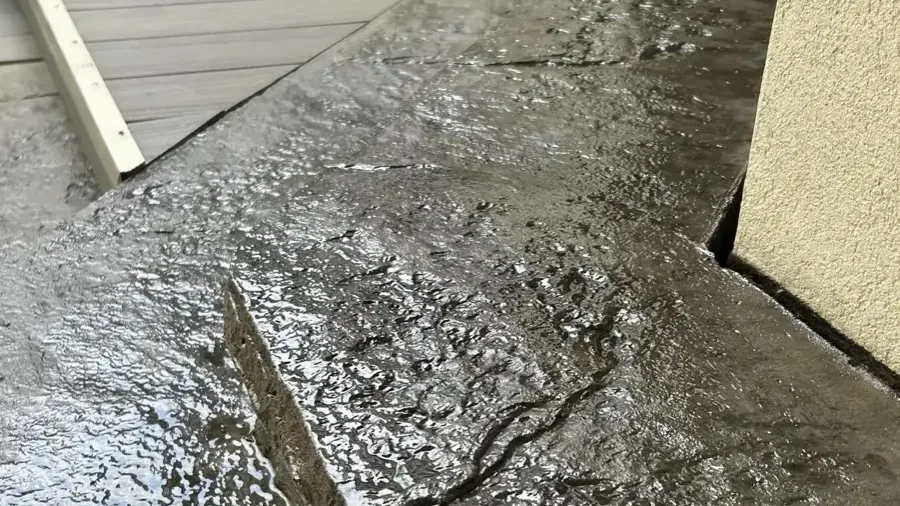
Sealing concrete in winter is rarely a good idea in Ontario. Most concrete sealers need a dry, unfrozen slab and a minimum temperature, often about 5 to 10 °C and rising, that holds until the sealer has cured. Frost and trapped moisture cause cloudy, patchy or peeling sealer. Your product label has the real limits, and this guide shows how to read them.
In This Article
- Sealing concrete in winter: the temperature limits
- Why an unfrozen, dry slab matters as much as the temperature
- Penetrating and film-forming sealers in cold weather
- When to apply concrete sealer in Waterloo Region
- If the window has closed: protect the slab until spring
- Garage floors and heated spaces
- What to ask a contractor who offers to seal in the cold
- Cold-weather concrete sealing questions
Sealing concrete in winter: the temperature limits
There is no single legal or industry number. Each product label sets its own limits, and the label is the rule. Most labels state three things:
- A minimum air temperature during application.
- A minimum surface (slab) temperature, which can differ from the air.
- A cure window after application, during which the temperature must stay above the minimum and no rain or frost can reach the surface.
Labels commonly set the minimum at roughly 5 to 10 °C and rising, though some products allow lower and some need more. That range explains why a cold November day can suit one product and ruin another.
The slab is the number that matters. A shaded slab on a spring morning can sit several degrees below the air temperature, because concrete can lag the air as it warms. An inexpensive infrared thermometer reads the surface in seconds. Also read the overnight forecast, since the first night after application counts as part of the cure. "Rising" means starting in the morning, not the late afternoon, when the temperature is about to fall.
For Waterloo Region, Environment Canada publishes climate normals, which are 30-year averages, by station. Look up the monthly temperatures for October, November, March and April before you plan a shoulder-season job.
Want an exact price for your home?
Skip the guesswork: we look at your actual property and quote it in writing, free and no-obligation. Serving Kitchener, Waterloo, Cambridge & Guelph.
Why an unfrozen, dry slab matters as much as the temperature
Cold is only half the problem. Moisture is the other half, and winter slabs are rarely dry.
- A frozen slab has ice in its pores. A penetrating sealer cannot soak in where ice has filled the space. A film bonds to frost or ice and then lets go when it melts.
- A damp slab traps water. A film-forming sealer sealed over moisture can turn white or milky, or blister and peel. Our cloudy sealer guide covers the causes and fixes.
- Dew and frost return every morning in late fall, so a slab that looked dry at noon may be damp again by seven.
- Cool, damp weather slows drying. After rain or snowmelt, the label's dry time may stretch well beyond the usual day or two, especially in shade.
A simple field check: tape a clear plastic sheet, about 45 cm (18 in) square, flat to the slab on all four sides and leave it for 24 hours. Water beads or condensation under the plastic means the slab is still giving off moisture. It is a rough test, not a lab result, but it beats guessing.
Penetrating and film-forming sealers in cold weather
Cold hurts the two main families of sealer in different ways.
| Sealer type | What happens in the cold |
|---|---|
| Water-based acrylic (film-forming) | The particles must fuse as water leaves. In the cold they may not, which leaves a weak, chalky or cloudy film. |
| Solvent-based acrylic (film-forming) | It dries more slowly in the cold, can trap solvent, and gives off flammable vapour that needs ventilation. Read the safety data sheet. |
| Two-part coatings such as epoxy or urethane | They cure by chemical reaction, which slows sharply when cold. Labels set firm minimums. |
| Penetrating (silane, siloxane or a blend) | The chemistry is less fussy about cold on some labels, but the slab must be dry and unfrozen so the product can soak in. |
Penetrating products often leave the surface looking natural, and film-forming ones add colour or sheen. For how the two types age, see how long concrete sealer lasts in Ontario. Whatever you choose, "it was a mild day" does not override the label.
When to apply concrete sealer in Waterloo Region
Late spring through early fall is the dependable window. In the shoulder months, October and April, a few good days appear, and they are short.
- Late fall. Days get shorter, and the clocks go back on the first Sunday in November, which cuts afternoon drying time. Overnight lows near freezing, dew and leaf litter all work against you.
- Early spring. The ground is thawing, slabs hold meltwater and road-salt residue, and cold nights are common. A single warm afternoon is not a window.
- Summer. Fine, with a different risk. Hot midday sun can make a film skin over too fast, so start in the morning.
Before you spray concrete sealer, check this list on the morning of the job:
- The slab is clean, dry to the touch and has had the label's dry time since the last rain.
- Air and slab temperatures are above the label minimum, and the forecast low stays above it for the cure window.
- No rain, frost or snow is expected during that window.
- The wind is calm enough that spray does not drift onto glass, cars or plants.
- The slab is out of hot direct sun, or you are working in the cool of the morning.
A new slab has its own rules. See when you can seal new concrete. Asphalt follows different labels, covered in our guide to driveway sealant temperature and timing.
If the window has closed: protect the slab until spring
Waiting is better than a failed coat. A film applied in poor conditions usually has to be stripped before the slab can be done again, which costs more than waiting did. In the meantime, you can reduce winter wear on an unsealed slab.
- Shovel early. The Region of Waterloo advises clearing snow as soon as you can, before it packs down and turns to ice.
- Use salt sparingly. The Region says a few tablespoons per square metre is often enough, on ice only. Below about -10 °C, salt stops working, so use sand or grit for traction.
- Keep salty snow off the slab. Do not pile plowed slush on it.
- Rinse in spring. Wash off residue once the slab thaws, before sealing.
Our guide to de-icing without damaging concrete or interlock goes through the options. A first-winter slab is more at risk, so the new concrete guide linked above matters if yours is under a year old.
Garage floors and heated spaces
The label's limits apply to the air and slab where the product goes down, not to the date. A heated garage floor held within the label's range, dry and well ventilated, can be a different case from an outdoor driveway in January. An unheated garage follows the outdoor rules. Fumes from solvent-based products are a real hazard in enclosed rooms, so follow the safety data sheet and ventilation instructions.
What to ask a contractor who offers to seal in the cold
A company that does concrete sealing should be willing to move the date. Ask these questions before you pay a deposit:
- Which product is it, and what is its minimum air and slab temperature?
- How will you check that the slab is dry and above that temperature on the day?
- What does the forecast say for the whole cure window, including the first night?
- What happens if the weather turns, and who pays to fix a failed coat?
- Can I have the quote and the product name in writing?
D&D Home Services does concrete sealing in Kitchener-Waterloo and gives free written quotes, so you can compare the product and the conditions in writing.
Cold-weather concrete sealing questions
Can you seal concrete in cold weather?
Only within the product label's limits. Most sealers need the air and slab to stay above a minimum, often about 5 to 10 °C, for application and cure, and the slab must be dry and unfrozen. In an Ontario winter those conditions are rare, so spring or fall is the safer choice.
What is the minimum temperature for sealing a driveway in winter?
It depends on the sealer. Many labels list roughly 5 to 10 °C and rising, for both air and surface, through the cure period including the first night. Some penetrating products allow lower and some two-part coatings need more. Read your product's label, because that number overrides any general guide.
When should I spray concrete sealer?
Spray on a dry, calm day when the slab is clean, dry and above the label minimum, and when no rain or frost is forecast for the cure window. Start in the morning as temperatures rise, and avoid hot direct sun. Late spring through early fall is the dependable window in Ontario.
Can concrete sealer be applied when it is about to rain?
No. Rain before the film has set can wash off or dilute a film-forming sealer, and rain before a penetrating one's rain-free time is up can reduce how well it works. Labels give a dry period after application, so check the multi-day forecast before you start and wait if the window is short.
Key Takeaways
- Each product label sets minimum air and slab temperatures, often around 5 to 10 °C and rising, plus a cure window.
- A frozen or damp slab blocks penetrating sealers and traps moisture under film-forming ones.
- Water-based acrylics, solvent-based acrylics, two-part coatings and penetrating sealers fail differently in the cold.
- Late spring to early fall is dependable. October and April offer only short windows.
- If the window has closed, wait for spring and shovel early, use little salt and rinse in spring.
Sources & References

Request a home-service quote
Select the service you need and describe the work area and access.