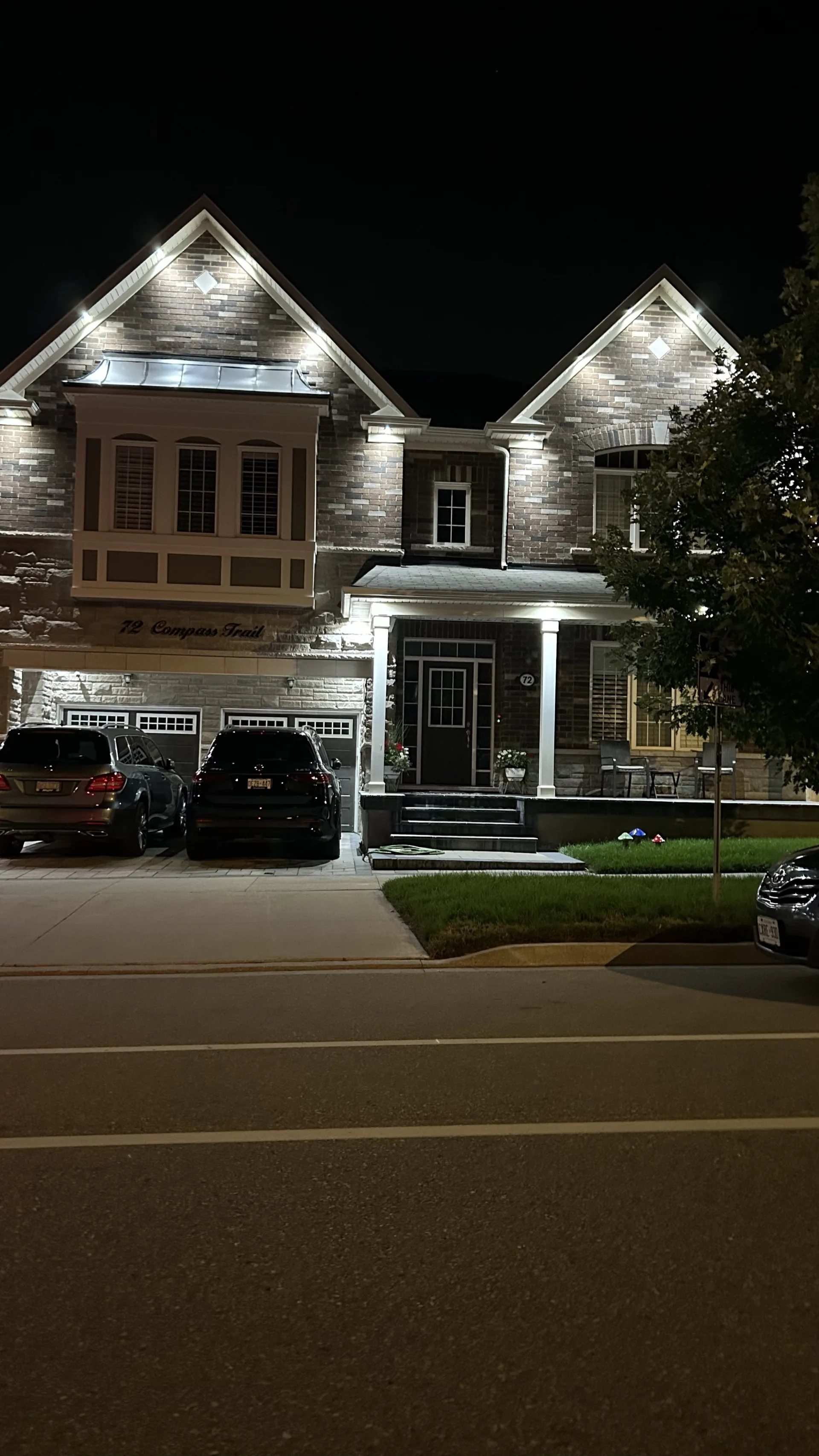
Why do LED Christmas lights flicker? Usually because of a loose or wet connection, too many strings on one run, a dimmer or timer that does not suit LEDs, or a tired power adapter. The cold itself is rarely the cause. Most checks are quick and safe with the lights unplugged. Cut wires, sealed strings and a flickering roofline run are different matters.
In This Article
- Why do LED Christmas lights flicker? Read the pattern first
- Loose plugs, bulbs and connectors: check these first
- Moisture and cold: why lights act up in wet weather
- Overloaded runs, dimmers and timers: when the power is the problem
- Half-lit, dim or burnt-out strings: what you can fix
- Safe homeowner fix, or a job for the installer?
- LED Christmas light problems homeowners ask about
Why do LED Christmas lights flicker? Read the pattern first
How a string misbehaves points to the cause. Match what you see to this table before you touch anything.
| What you see | Likely cause | First check |
|---|---|---|
| Flickers when the wind blows or a cord is touched | Loose plug, loose bulb or a worn connector | Unplug and reseat every connection |
| Flickers or trips the GFCI only in wet weather | Water in a plug or connector | Dry it, and raise the joint off the ground |
| Dim toward the end of a long run | Too many strings joined, or too much cord | Count strings against the label |
| Flickers or buzzes on a dimmer | A dimmer not made for LEDs | Plug in without the dimmer to test |
| Half the string is dark | A loose, missing or failed lamp or section | Look for the first dark lamp |
| Whole string dead | Blown plug fuse, tripped GFCI or failed adapter | Test another outlet and check the fuse |
| Faint flicker from the first night | A basic power circuit built into the string | Compare with another brand of string |
That last row is a design quirk, not a fault. Some inexpensive strings pulse faintly at the frequency of household power. You may notice it at the corner of your eye or as bands on a phone video. If a string flickered from day one and has not changed, it is probably just how it is built.
Want an exact price for your home?
Skip the guesswork: we look at your actual property and quote it in writing, free and no-obligation. Serving Kitchener, Waterloo, Cambridge & Guelph.
Loose plugs, bulbs and connectors: check these first
Unplug the string before you touch it. Then work from the plug outward.
- The plug. Push it fully into the outlet or the previous string. Look for bent blades or a plug that wobbles.
- The joints. Where one string meets the next, press the connectors together until they sit snugly.
- The lamps. On sets with removable bulbs, press each one gently into its socket. A single loose bulb can cause flicker or a dark section.
- The fuse. Many plugs have a small fuse compartment. Replace a blown fuse only with the type and rating printed on the plug or in the instructions.
- The cord. Look for cracked insulation, crushed sections and exposed wire.
The Electrical Safety Authority (ESA) advises replacing damaged cords, plugs and ornaments, and connecting no more than three light strings together. If you find damage, replace the set. Do not tape it.
Moisture and cold: why lights act up in wet weather
Water in a plug or connector causes intermittent contact, which looks like flicker, and it can trip a ground fault circuit interrupter (GFCI). The ESA says to use lights rated for outdoor use and to use GFCIs for outdoor connections. Its outdoor guidance adds that the GFCI should have a weatherproof cover.
To keep joints dry:
- Hang plugs and connectors above the ground, with the open end pointing down so water drips off.
- Keep them out of snow, puddles and downspout splash.
- Use a cover or sealed box where the label allows.
- If a joint gets wet, unplug it and let it dry fully before you power it again.
The cold is a smaller culprit than people expect. Natural Resources Canada (NRCan) lists good performance in cold temperatures as an advantage of LEDs. What cold does is stiffen cords, and insulation can crack if bent sharply. Unreel strings indoors, let them warm up and handle them gently.
Overloaded runs, dimmers and timers: when the power is the problem
Every string has a label that gives its maximum number of connected sets and its wattage. That label is the limit. Joining too many strings pulls the voltage down along the run, so the lights at the far end look dim or flicker. The fix is to feed the display from more than one point, each on its own outlet or outdoor-rated cord. Avoid overloading cords or circuits, as the ESA warns that too many decorations can overheat and cause fires.
Dimmers and timers can cause flicker too.
- Dimmers. An ordinary wall dimmer made for incandescent bulbs can make LEDs flicker, buzz or dim in steps. Use a dimmer made for LED loads, and only on strings that say they are dimmable.
- Timers and smart plugs. Some struggle with the very low power draw of LEDs, which can show up as flicker or a faint glow when off. Check the rating, and choose one that says it suits LEDs.
- Mixed strings. Do not join different types of string unless the label says you can.
To test, plug the string straight into a GFCI outlet with no timer or dimmer. If the flicker stops, you have found the cause. The Christmas light installation cost guide explains how power and circuits shape a larger display.
Half-lit, dim or burnt-out strings: what you can fix
Do LED Christmas lights burn out? Not like an old filament bulb. NRCan says an LED reaches the end of its useful life when it puts out only 70 per cent of its original light, so ageing LEDs fade slowly. A string that has gone dark or half-dark has usually failed somewhere else, such as a connection, a section, a fuse or the adapter.
Many strings are wired in sections, so one loose or failed lamp can darken everything after it. To fix a half-lit string:
- Unplug it and find where the dark part starts.
- Check the last lit lamp and the first dark one. Press them in, or swap in a spare if the bulbs are replaceable.
- Check the plug fuse, and try another outlet.
- Check every connector in the run.
Can you fix LED Christmas lights? Sometimes. Reseating a lamp, changing a fuse and fixing a loose connection are fair jobs. Cutting a cord, splicing wire, opening a sealed power adapter or repairing a water-damaged string are not. Replace those sets.
Dimness has other causes. An old string may simply be fading, and a new string beside it will look brighter. A long run may be starved of power, as covered above.
Safe homeowner fix, or a job for the installer?
Fix it yourself, from the ground or a low, stable ladder, when the cause is one of these: a loose plug or bulb, a blown plug fuse, a damp connector you can dry, a string count that is too high, or a timer or dimmer that does not suit LEDs.
Stop and get help when you see any of the following:
- A hot plug or hot adapter, melted plastic, burn marks or a burning smell.
- Buzzing, crackling or repeated GFCI trips.
- Exposed wire or a cracked power adapter.
- Any fault that needs a ladder at a roof edge in cold, wet or icy conditions. The Canadian Centre for Occupational Health and Safety says not to use ladders on ice, mud or other slippery surfaces, and the ESA says to stay at least 3 metres from overhead power lines. See also the ladder safety guide.
If a permanent LED roofline run flickers, call the company that installed it. Opening a power supply or controller yourself may affect your warranty, and the installation guide shows where those parts sit and why they need steady, protected power.
If you would rather not climb at all, D&D Home Services handles holiday lighting install, takedown and storage from $750 for a typical Kitchener-Waterloo home. A new outdoor outlet or any hardwired connection is electrical work for a Licensed Electrical Contractor, and D&D does not do it.
LED Christmas light problems homeowners ask about
Do LED Christmas lights flicker normally?
Some do, faintly. Certain inexpensive strings pulse at the frequency of household power, and you may see it at the corner of your eye or as bands on a phone video. If a string flickered from the first night and has not changed, that is probably its design. New or worsening flicker means something has changed, so check the connections.
Why do LED Christmas lights burn out?
LEDs rarely burn out like filament bulbs. They fade slowly over many hours, so a dead section usually points to a loose or wet connection, a failed segment, a blown fuse or a tired adapter. Heat, moisture and damaged cords shorten the life of any string, so keep joints dry and replace damaged sets.
How do you fix LED Christmas lights that are half out?
Unplug the string and find where the dark section starts. Press in the last lit lamp and the first dark one, swap in a spare if the bulbs are replaceable, check the plug fuse and try another outlet. If the cord is damaged or the string is sealed, replace it instead of splicing.
Why are my LED Christmas lights dim?
Common causes are too many strings joined together, a long run that loses power toward the end, a dimmer set low, a timer not suited to LEDs, or an older string that has faded next to a new one. Check the label for the connection limit, test without the dimmer, and feed long displays from more than one outlet.
Key Takeaways
- Most LED flicker comes from loose or wet connections, overloaded runs, or a dimmer or timer that does not suit LEDs.
- Unplug first, then check the plug, joints, lamps, fuse and cord, working outward from the outlet.
- Keep plugs and connectors off the ground, pointing down, and let wet joints dry before reconnecting.
- Replace damaged, cut or sealed strings. Do not splice or tape them.
- Hot parts, burn marks, repeated GFCI trips and any fault at the roof edge are jobs for a professional.
Sources & References

Request a home-service quote
Select the service you need and describe the work area and access.