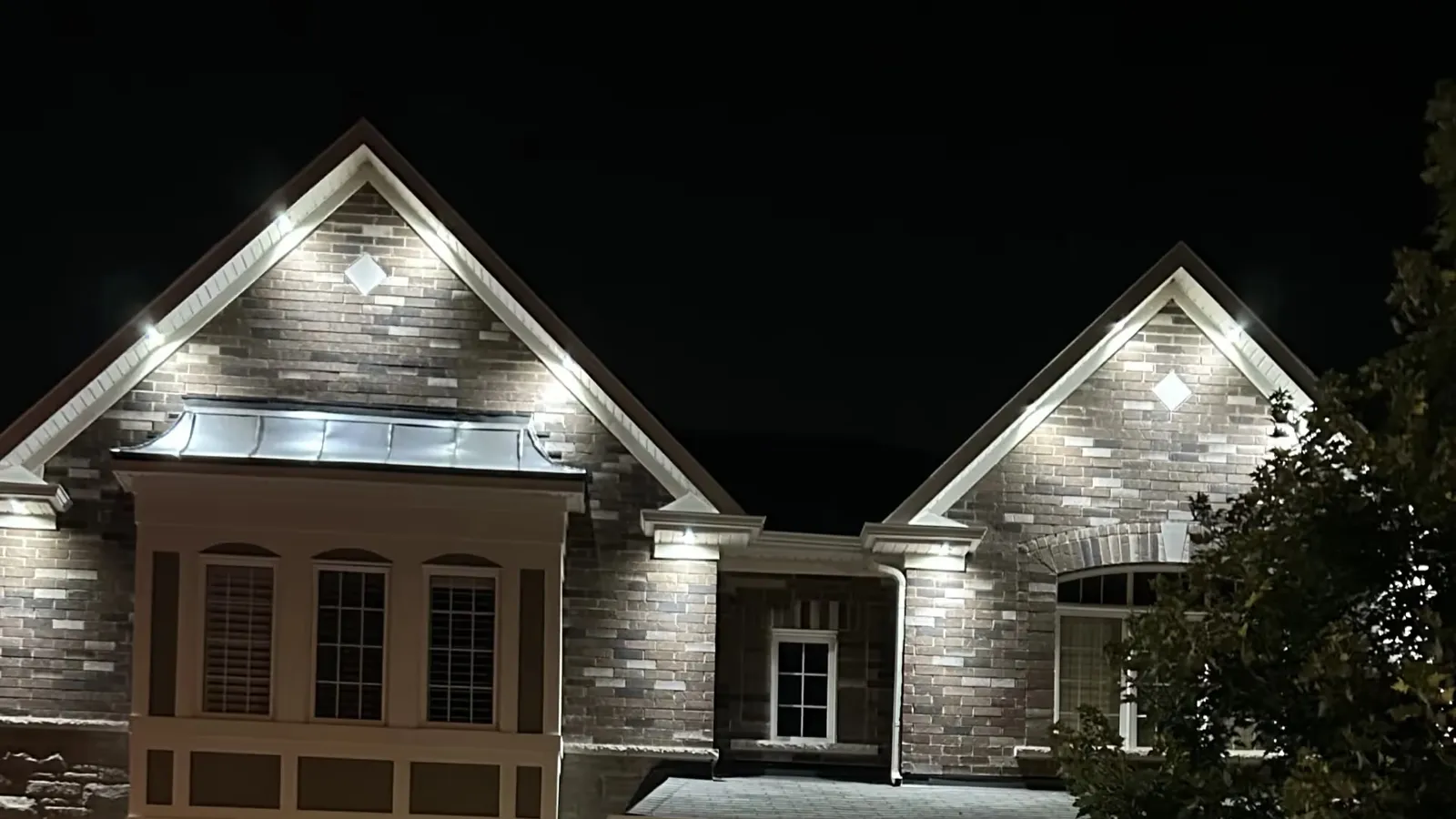
Permanent Christmas lights DIY is realistic on a low roofline with sound fascia and a GFCI-protected outdoor outlet already nearby. It is a poor bet on a two-storey front, when a new outlet is needed or when the wood at the roof edge is soft. The kit is the easy part. Height, power and mounting decide whether the job is safe and whether it lasts.
In This Article
- Permanent Christmas lights DIY or a pro: the quick comparison
- Working at height is the real price of a DIY roofline
- Wiring and the outdoor outlet: where DIY kits get complicated
- Mounting the track: what a poor job costs to fix
- Warranty gaps and kit fine print
- How to price a kit against a professional quote for your own house
- Choose a kit if, call a pro if
- Permanent lights DIY questions homeowners ask
Permanent Christmas lights DIY or a pro: the quick comparison
A permanent system is a track fastened along the roof edge, LEDs seated in the track, and a power supply and controller tied to household power. A kit sells you those parts. It does not sell you ladder skill, electrical work or a tidy fastening job, and that is where DIY projects go wrong. Here is how the two routes compare.
| Factor | DIY kit | Professional install |
|---|---|---|
| Reaching the roofline | You supply the ladder, the footing and the nerve | A crew with access equipment and fall-protection training |
| Power | You find an outlet, or arrange a new one | The installer plans supply positions, but a new outlet is still separate electrical work |
| Mounting | You pick the fasteners and do the sealing | The installer picks and seals, and should probe the fascia first |
| Warranty and support | Seller's product terms, which vary | Installer's workmanship terms plus the product's, so ask for both in writing |
| If a section fails | You find it, reach it and fix it | Ask what the installer does and for how long |
A kit looks cheaper because its price leaves out your time, the access equipment and any electrical work. Put those back before you compare.
Want an exact price for your home?
Skip the guesswork: we look at your actual property and quote it in writing, free and no-obligation. Serving Kitchener, Waterloo, Cambridge & Guelph.
Working at height is the real price of a DIY roofline
Clipping a string of lights to an eave is a short job. Fitting a permanent track is not. You stay at the eave for hours with both hands busy, holding a level, a drill and a length of aluminum that catches the wind. That is a different risk.
The Canadian Centre for Occupational Health and Safety (CCOHS) calls falls from portable ladders a major source of serious injury. Its basics apply to you. Set the base one unit out for every four units up. Keep two hands and one foot, or two feet and one hand, on the ladder. Keep ladders away from overhead power lines. The Electrical Safety Authority (ESA) says to stay at least 3 metres from them, so look at where the service drop and mast sit before you set a ladder anywhere near the front of the house.
Peaks, gables and a garage roof below an upper window all make it harder, because the ladder has to land on a roof or on ground that is not level. Ontario's Working at Heights training exists for workers because these are the places where falls happen. As a homeowner you are not required to take it, but the hazard at the eave is the same. For setup basics, read our guide to ladder safety for exterior home maintenance.
A simple rule: if you cannot reach every point of the run from a ladder on level ground without leaning out, do not do it yourself.
Wiring and the outdoor outlet: where DIY kits get complicated
The power supply and controller need steady, protected power all year. Many kit buyers underestimate this part.
- An outlet that already exists. If a GFCI-protected outdoor outlet sits close to where the supply will mount, plugging in is simple. ESA advises ground fault circuit interrupter (GFCI) protection for outdoor connections.
- No extension cord as a fix. ESA says never to run cords through doors or windows, and that holiday decorations are not meant for year-round use. A cord feeding a permanent system is a long-term workaround, which is what that advice warns against.
- A new outlet or hardwired connection. This is electrical work. If you hire someone for it in Ontario, ESA says it must be a Licensed Electrical Contractor. Ask for their ECRA/ESA licence number, and keep the ESA Certificate of Acceptance. D&D Home Services does not do electrical work, so a new outlet is a separate job with a separate contractor.
ESA does let homeowners do their own electrical work in their own homes, but only with a notification of work filed before you start and an ESA inspection at the end. It still recommends hiring a licensed contractor.
Distance matters too. Low-voltage lines lose power over length, so a long run often needs more than one power supply, each with protected power nearby. The kit instructions state the longest run one supply can feed. Add up your whole roofline before you buy, so you know how many outlets you need, not just one.
Mounting the track: what a poor job costs to fix
A track is only as good as the board it is fastened to. Most DIY problems start here, and many stay hidden until water gets in.
- Soft or rotten fascia. Screws in wet wood do not hold, and every hole is a path for water. Probe the board with a screwdriver tip at corners, under joints and below any drip before you drill.
- The wrong fastener for the material. Wood, aluminum and vinyl each need something different. Follow the track maker's fastening instructions, and seal every hole made through fascia or soffit.
- A wavy line. A rigid track is seen every day in daylight. Sags and kinks that a string of lights would hide show up on aluminum. Snap a chalk line and use a level before the first screw.
- Dark spots. Test every section before the cover goes on. A failed section is far easier to swap before the track is closed up.
What does a bad mounting job cost to fix? A crooked track means taking sections down, filling and sealing the old holes and starting again. Water that gets behind the track can rot the fascia, and replacing fascia means removing the run. If the eavestrough needs replacing later, it is fastened to the same board. The guide on whether permanent lights damage eavestroughs or fascia explains what to check first.
Warranty gaps and kit fine print
A kit's price does not tell you what happens when something fails. Ask before you buy, and get answers in writing where you can.
- What is covered. Parts only, or replacement lengths too? Are the track, LEDs, power supply and controller covered separately?
- What can void it. Some sellers set conditions on who installs the system or how it is powered. Ask whether your own mounting or outlet changes anything.
- Certification. Look for a certification mark accepted in Canada, such as CSA or cUL, on the power supply, and confirm it suits Canadian household power.
- Replacement parts. Will the same track and LEDs still be sold in three years, in the same shade of white?
- Insurance. ESA warns that insurance claims tied to unlicensed electrical work may be denied, so ask your insurer how it treats uninspected work.
Professional installs have gaps too. Ask the installer for workmanship terms, and who services the system and for how long.
How to price a kit against a professional quote for your own house
Compare the two routes for the same roofline, line by line.
- Measure the run. Walk every edge you want lit. Count both sloped sides of each peak, which are longer than the width of the gable below. Add a little for corners and cuts, and note the outlets within reach.
- Price the kit in full. Track, LEDs, power supplies, controller, fasteners, sealant, any access equipment you must buy or rent, and a new outlet from a Licensed Electrical Contractor if you need one. Add an allowance for fascia or eavestrough repairs that must happen first.
- Count your hours and your risk. Add the ladder time, and decide who pays if a section fails or a screw lands in the wrong place.
- Get a written quote. Ask that it list the length lit, the product, the number of power supplies, any electrical work as a separate line and the service terms.
- Compare totals and terms, not headline prices.
D&D Home Services does not publish a price for permanent LED roofline lighting, because the number depends on the length, height and layout of the house. Quotes are free and confirmed in writing before work begins, which gives you a real figure to hold your kit total against. To see what a professional job involves, read how permanent LED roofline lighting is installed.
Choose a kit if, call a pro if
A kit can make sense if all of these are true:
- The roofline is one storey and you can reach every point from a ladder on level ground.
- A GFCI-protected outdoor outlet is already close to where the power supply will go, or you will hire a Licensed Electrical Contractor for a new one.
- The fascia and soffit are sound, and any eavestrough or fascia repairs are done.
- You are comfortable measuring, cutting aluminum, sealing and testing, and someone can spot the ladder.
Call a pro if any of these apply: a two-storey front, steep peaks, a lower roof beneath upper windows, power lines near the front of the house, a new outlet needed, fascia you have not checked, or a long run that needs several power supplies.
Dry, mild weather in September or October is far kinder than a frosty November morning, and sealants list minimum temperatures on the label. If you are still deciding between permanent and seasonal lights, see permanent LED lights vs seasonal Christmas lights.
Permanent lights DIY questions homeowners ask
Are permanent Christmas lights hard to install?
The parts are not complicated, but the setting is. You fasten a rigid track along the roof edge from a ladder, power it from a protected outlet and seal every hole. On a low roofline with a nearby outlet and sound fascia, a careful homeowner can manage. On a two-storey front, or when a new outlet is needed, most people should hire out the height and the electrical work.
Can I install permanent Christmas lights myself?
In principle, yes. ESA allows homeowners to do their own electrical work with a notification of work and an inspection, but it recommends hiring a Licensed Electrical Contractor. Plugging a certified power supply into an existing GFCI outlet is not new wiring. Adding an outlet or hardwiring is. For most people the ladder and fastening work is the bigger risk.
Is a DIY permanent lights kit cheaper than a professional install?
A kit costs less up front, but the total grows once you add access equipment, sealant, any new outlet, an allowance for repairs and your own hours. Price both routes for the same measured roofline, then compare totals, warranty terms and who services the system.
Can I buy a permanent Christmas lights DIY kit in Canada?
Kits are sold to Canadian buyers by several sellers. Before you order, check that the power supply carries a CSA or cUL mark and suits Canadian household power, that claims are handled in Canada, and that replacement track and LEDs will stay available.
Key Takeaways
- A DIY permanent lights kit suits a low, simple roofline with sound fascia and a GFCI-protected outdoor outlet already nearby.
- Height, power and mounting decide the job, not the kit itself.
- A new outdoor outlet or hardwired connection is electrical work for a Licensed Electrical Contractor under ESA rules.
- Compare a kit and a quote on the same measured run, including access equipment, electrical work, repairs and service terms.
- Ask about warranty conditions, Canadian certification and replacement parts before you buy.
Sources & References

Request a home-service quote
Select the service you need and describe the work area and access.