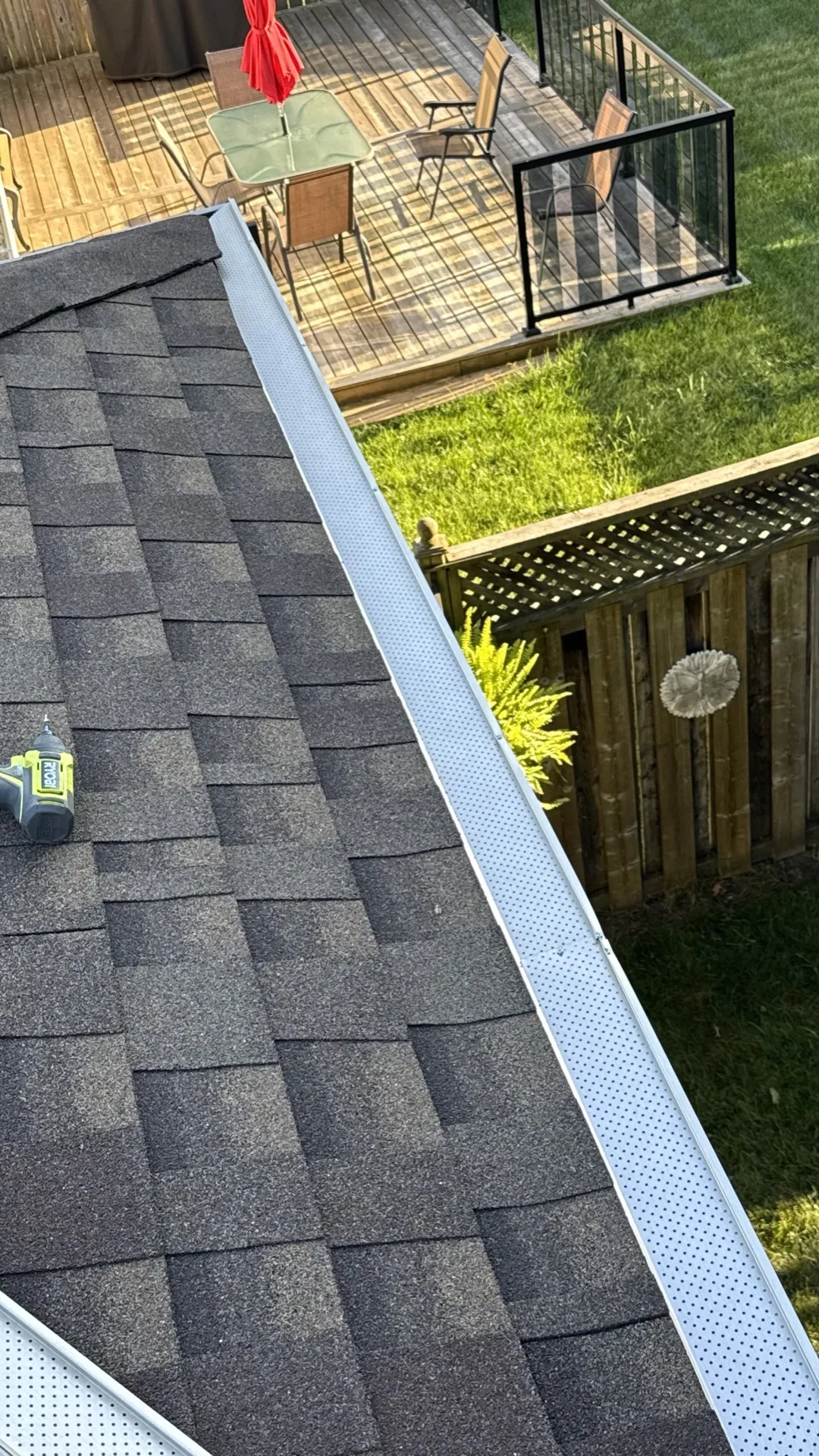
Leafguard gutters is a search term for covered eavestroughs, usually a hood-style cover that curves over the trough so rainwater follows the curve into a narrow slot while leaves fall past. It is one type of gutter guard among several. This guide explains how hoods work, how they compare with mesh, screen and insert guards in Ontario, and what to ask any installer before you compare quotes.
In This Article
- What people mean by leafguard gutters
- How a hood-style cover works
- Hood-style covers vs other gutter guards
- Integrated systems vs guards added to your eavestrough
- How hoods and other guards handle Ontario leaf drop, ice and cleaning
- Should you put leaf guards on your gutters?
- What to ask before you compare leafguard-style quotes
- Leaf guard questions homeowners ask
What people mean by leafguard gutters
The phrase is used two ways. Some people mean a specific company's product. Others use it for any gutter with a cover on top. This page is about the type, not about any brand, and it does not rank or review products.
In most cases the type is a hood-style cover, also called a reverse-curve or surface-tension guard. It is a solid cover that runs from the roof edge, over the trough and around the front lip. It reaches your home in one of two ways:
- Integrated system. The trough and the cover are supplied and installed together as one package, so you get a new eavestrough as well as the guard.
- Add-on cover. A cover is fitted to the eavestrough you already have.
That difference matters more to your budget and your repair options than the shape of the cover does.
Want an exact price for your home?
Skip the guesswork: we look at your actual property and quote it in writing, free and no-obligation. Serving Kitchener, Waterloo, Cambridge & Guelph.
How a hood-style cover works
Rain runs off the shingles and onto the cover. The cover rolls over the front edge, and water clings to that curve the way water clings to the back of a spoon. It then drops through a slot or opening along the nose and into the trough. Leaves and twigs have more momentum and less cling, so most carry on over the edge and fall to the ground.
The design has real strengths. There is no screen on top to mat over with wet leaves, the profile is low, and big leaves such as maple and oak shed off well on a reasonable roof pitch.
It also has limits that come from the same physics. Fast water off a long or steep roof, or out of a valley, can jump the slot. Small debris such as pine needles, seed pods and shingle grit can catch at the nose or slip inside. And once the cover is on, you cannot see into the trough. Our comparison of micro-mesh and reverse-curve guards looks at those trade-offs in more detail.
Hood-style covers vs other gutter guards
| Guard type | How it keeps debris out | Where it does well | What to watch |
|---|---|---|---|
| Hood or reverse-curve | Solid cover, water follows the curve into a slot | Large leaves, a low profile | Fast water, small debris inside the slot, hidden trough |
| Fine mesh | Water passes through a fine screen, debris stays on top | Needles, seeds and grit, easy to see from the ground | Fine debris can film the surface and slow water |
| Perforated or screen cover | Water passes through punched holes or a coarse screen | Larger leaves, lighter cost | Small debris passes through and holes can clog |
| Foam or brush insert | Sits in the trough and blocks the opening | Easy to fit yourself | Debris collects in it and seeds can take root |
No type removes every problem. The right one depends on what falls on your roof and how fast water comes off it.
Integrated systems vs guards added to your eavestrough
An integrated system makes sense when your eavestroughs are already due for replacement. You pay once for trough and cover, one supplier answers for both, and the pieces are designed to fit. The catch is that sound eavestroughs get torn out to make room, and later repairs or changes usually have to go back through the same supplier.
An add-on cover suits a trough that is in good shape. Before anything goes on, the run should be firmly hung, sloped toward the downspouts and large enough for your roof, because a guard hides a poor trough but does not fix it. If the trough is the wrong size, see our guide to choosing the right gutter size.
Price follows from this. A full system covers new eavestrough as well as guard, so the two are not like for like. Compare quotes by asking each company to state, line by line, what it is replacing, what it is keeping and what the cover itself costs.
How hoods and other guards handle Ontario leaf drop, ice and cleaning
Heavy maple and oak leaf drop arrives from late October into November, and maple seed pods follow in spring. Hoods handle the big leaves well. Seed pods and grit are the usual troublemakers, so look at the trees overhead before you decide.
Winter is the other test. Freeze-thaw cycles turn meltwater into ice, and on any cover ice can build at the front edge and block the opening. Ice dams come from heat escaping through the roof, not from the guard, and a guard will not prevent them. Check that the fastening can take the load of sliding snow.
Cleaning access is the biggest practical difference. A hood hides the trough, so ask how the installer would inspect and flush it, and whether sections lift or open. Whatever you choose, you will still need to look at it. Our article on whether guards still need professional cleaning explains what to expect.
Fastening matters for your roof too. Some covers tuck under the first row of shingles. Ask the installer and your shingle manufacturer, in writing, whether that affects your roof warranty.
Should you put leaf guards on your gutters?
Consider guards if:
- Mature maples or oaks overhang the roof and you clean more than once a year.
- Your eaves are two storeys high and cleaning means a long ladder.
- The eavestrough is sound, well hung and sloped correctly.
Wait, or choose differently, if:
- The troughs sag, leak or are near the end of their life. Repair or replace them first.
- Pines or fine seed pods supply most of the debris, since hoods are weakest against small material and fine mesh is built for it.
- The roof is large, steep or has valleys that shed water very fast.
- Nobody can tell you how the inside of the trough will be checked.
Guards cut cleaning. They do not end it.
What to ask before you compare leafguard-style quotes
Warranty wording is where quotes differ most, so get the terms in writing and ask:
- Who stands behind it, the manufacturer, the installer or both, and what happens if the installer closes?
- What is covered: defects in the product, installation workmanship, or clogging and overflow?
- Does the warranty require routine cleaning, and who does it?
- Does it pass to the next owner if you sell?
- Are repairs and cleaning access included, and are parts still available later?
- Does the fastening method affect your roof warranty?
D&D Home Services quotes several guard types for homes in Kitchener, Waterloo, Cambridge and Guelph and will explain which fits your trees and roof. Published pricing for gutter guards starts from $450 for typical Kitchener-Waterloo homes, and the final quote depends on the type, the length and the height. Details are on the gutter guard installation page.
Leaf guard questions homeowners ask
Are leafguard gutters worth the money?
It depends on your trees, how often you clean now and the shape of your eavestroughs. Guards pay off most where heavy leaf fall means frequent cleaning or high, awkward eaves. They are less useful on sagging troughs or where fine debris dominates. Compare the guard cost with what you now spend on cleaning, and read the warranty terms.
Do gutters with leaf guards still need cleaning?
Yes, less often. Fine debris, seed pods and grit still get through or settle on top, and a hood hides the trough, so a blockage can go unseen until water spills. Look at the edges from the ground each spring and fall, and after big storms, and arrange a proper flush when you see overflow.
How do leaf guards compare with a leaf filter or a gutter helmet?
Those names belong to specific product lines, and each has its own design and warranty. Compare the type of cover first: hood, fine mesh, perforated screen or insert. Then compare the warranty, who installs it and how the trough can be reached for cleaning. The brand name tells you less than those details.
Which type of gutter guard should I choose?
Match the guard to your debris. Hoods suit large leaves on moderate roofs. Fine mesh suits needles, seeds and grit. Perforated screens are a lighter-duty option, and inserts need frequent attention. Check the trough is sound first, then compare several types in writing, including how each is inspected and cleaned.
Key Takeaways
- Leafguard gutters usually means a hood-style cover that guides rain around a curve into a slot while leaves fall past.
- Hoods handle large leaves well but can struggle with fast water, small debris and ice at the nose.
- An integrated system supplies new trough and cover together. An add-on cover goes on the eavestrough you already have.
- Guards reduce cleaning but do not end it, and a hood hides the trough, so ask how it will be inspected.
- Compare warranty terms, roof-warranty effects and repair access in writing before you compare prices.

Request a home-service quote
Select the service you need and describe the work area and access.