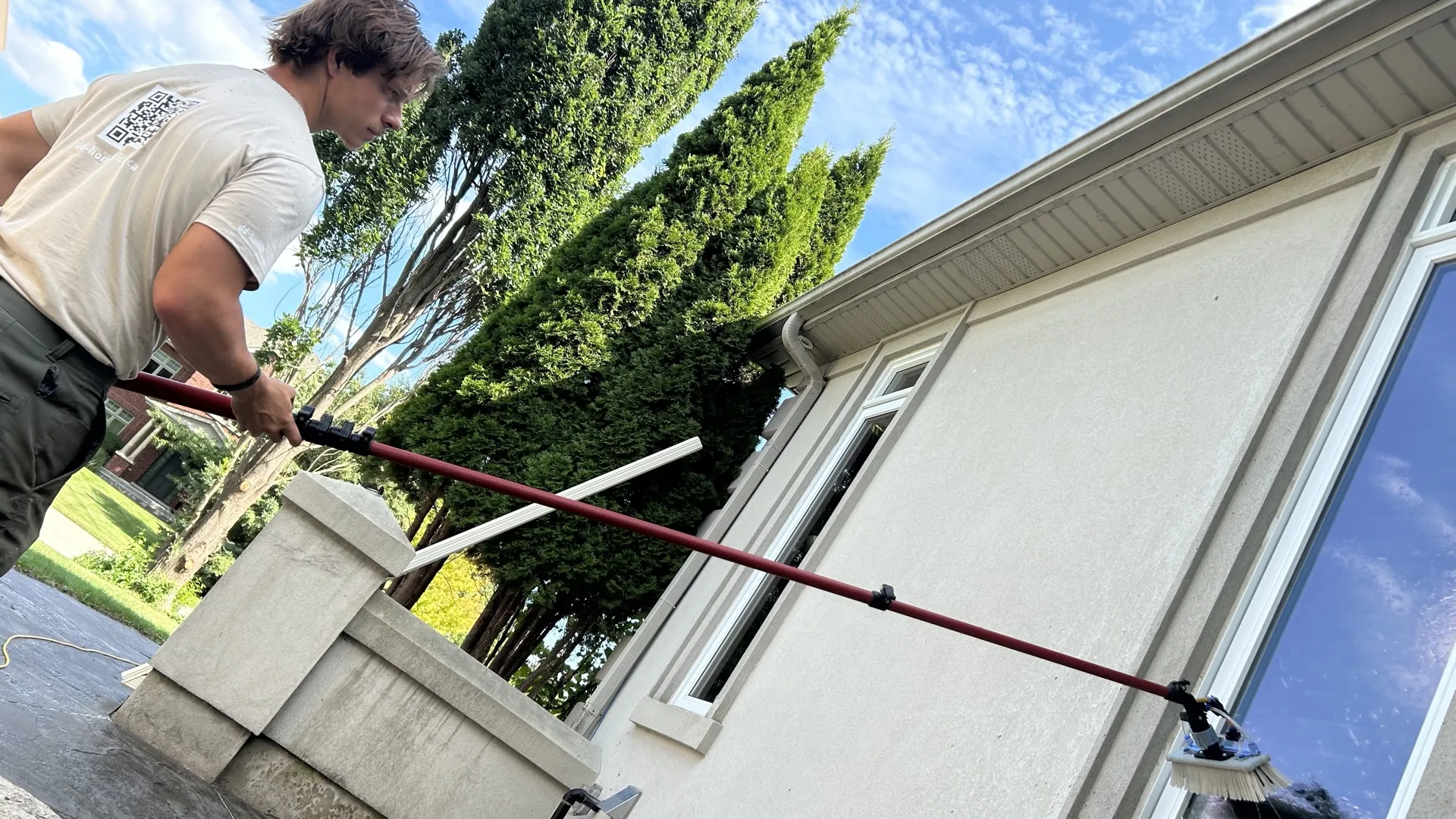
DIY window cleaning is a good deal for some windows and a poor one for others. Here is what you actually take on, where DIY wins, where a professional pays for themselves, the costs people forget, and a decision grid you can apply window by window.
In This Article
What you actually take on when you clean windows yourself
The job is bigger than a bottle and a cloth. For a whole house, you take on all of this.
- Tools. A squeegee and washer sleeve, a bucket, microfibre cloths, a scraper, a pole for reach, and a ladder with a standoff if any glass sits above arm's length.
- Prep. Moving furniture, laying towels, taking out screens and clearing sills.
- The work itself. Pre-rinse, wash, squeegee and detail the edges, one pane at a time, in weather that suits the job.
- The extras. Screens, tracks and sills, which do not show up in most plans but do show up in the result.
- Cleanup. Drying tools, emptying buckets and putting everything away.
Then there is the learning curve. Streak-free glass takes practice, and the first few windows are usually the ones you redo.
Where DIY wins
- Ground-floor glass on a small or medium home. You are standing on the ground, and mistakes are cheap.
- Interior windows. A little soap, microfibre and a squeegee do the job, and you work at your own pace.
- Touch-ups between visits. A patio door or a kitchen window that gets fingerprints does not need a crew.
- People who like the job. If washing windows is satisfying to you, the trade-off changes.
- A tight budget this season. A do-it-yourself clean on a few windows beats no clean at all.
Streaky glass no matter what you try?
We clean interior and exterior glass to a streak-free finish for homes across Kitchener, Waterloo, Cambridge & Guelph. Free, no-obligation quotes, ready within 1 business day.
Where a professional pays for themselves
- Anything beyond a safe stance. Second-storey glass, dormers, and windows over roofs, decks or steep grades.
- Established hard-water deposits. They need the right products and patience, and pure-water rinsing helps stop new ones forming.
- Post-renovation residue. Paint, plaster, stickers and construction dust take experience to remove without scratching.
- Skylights and other risky glass. These are not a place for a first attempt.
- Big jobs. When your time is the scarce resource, buying it back is a fair trade.
- Insurance and accountability. A company that carries liability insurance answers for damage, and you have someone to call if a spot was missed.
What the glass looks like afterward
A careful homeowner can match a professional on a ground-floor window. The difference shows up at the edges and in the volume. Corners, the bottom edge of a pane and the frame are where most DIY jobs fall short, because those spots need a second cloth and a steady eye. Across a whole house, consistency also drifts: the first windows get careful attention and the last ones get whatever energy is left.
Hard water is the other gap. Rinsing with tap water and letting it dry leaves faint spots that are hard to see on the day and obvious a week later in low sun. Crews who use pure water or wipe every pane dry avoid that, which is much of what you are paying for.
The costs people forget
Equipment adds up. A good squeegee, sleeves, poles, filters and a proper ladder are not one-time costs, since rubber blades and sleeves wear out and need replacing. Storage matters too, because these tools live in a garage or shed.
Risk is the larger hidden cost. Falls from ladders are a well-known cause of serious injury, and a single mistake at height costs far more than a year of professional visits. Damage is another. Scratched glass, bent screens, soaked wood sills and water forced past seals can all follow from rushing, and none of them show up on a shopping list.
And then there is rework. Windows with streaks or spots get redone, and a redone window is a second use of a Saturday.
A decision grid, and a hybrid that suits many homes
| Situation | DIY | Professional |
|---|---|---|
| Ground-floor interior glass | Yes. | Only if you want it done for you. |
| Ground-floor exterior glass on a small home | Reasonable. | Reasonable. |
| Second-storey exterior glass | Only with a safe tilt-in or pole. | Usually the better choice. |
| Hard-water spots that have built up | Fresh spots, yes. | Established crust, usually. |
| Skylights, dormers, glass above roofs | No. | Yes. |
| After renovations | Light dust only. | Paint, plaster and stickers. |
A hybrid works well for many homes: book a professional for the exterior visits and the upstairs glass, and do ground-floor interiors and touch-ups yourself. D&D Home Services quotes window cleaning from $125 for typical Kitchener-Waterloo homes, and its crew members are Working at Heights certified. For related guides, read DIY versus professional exterior cleaning and ladder safety for exterior home maintenance, and see window cleaning for a visit.
Key Takeaways
- DIY suits ground-floor glass, interiors and touch-ups, and a professional suits height, hard-water build-up and renovation residue.
- The costs people forget are equipment wear, storage, the fall risk of ladders, damage and rework.
- Apply the decision window by window, not house by house.
- A hybrid, with a professional for exterior and upstairs glass and you on ground-floor interiors, suits many homes.

Request a home-service quote
Select the service you need and describe the work area and access.