The PSI printed on a pressure washer is only half the story. Tip angle, distance and flow decide what actually reaches the surface. This guide gives rule-of-thumb starting ranges for the materials around a Southern Ontario home, then a test routine that beats any table.
In This Article
What the numbers on the box actually mean
PSI (pounds per square inch) is how hard the water is pushed at the pump. GPM (gallons per minute) is how much water the machine moves. Force comes from pressure, but rinsing speed comes from flow, and a rough measure of cleaning power is the two multiplied together.
The label figure is measured at the machine, not at the surface. Between the two sit the tip and your distance. A 0-degree tip at close range can be far harsher than a 40-degree tip held at arm's length, on the very same machine. For a homeowner with a fixed-pressure unit, tip and distance are the real pressure controls.
Starting points by surface
These are commonly quoted starting points, not tested limits. Your machine's manual and the material maker's care guide come first.
| Surface | Rule-of-thumb start | Tip to begin with | Watch for |
|---|---|---|---|
| Sound concrete | Up to about 3,000 PSI, ideally through a surface cleaner | 25 or 40 degrees on a wand; surface cleaner for big flat areas | Stripes, etching, lost surface paste |
| Interlock pavers | Roughly 1,500 to 2,500 PSI, lower on older units | 40 degrees, held back, or a surface cleaner | Joint sand blown out, loosened edges |
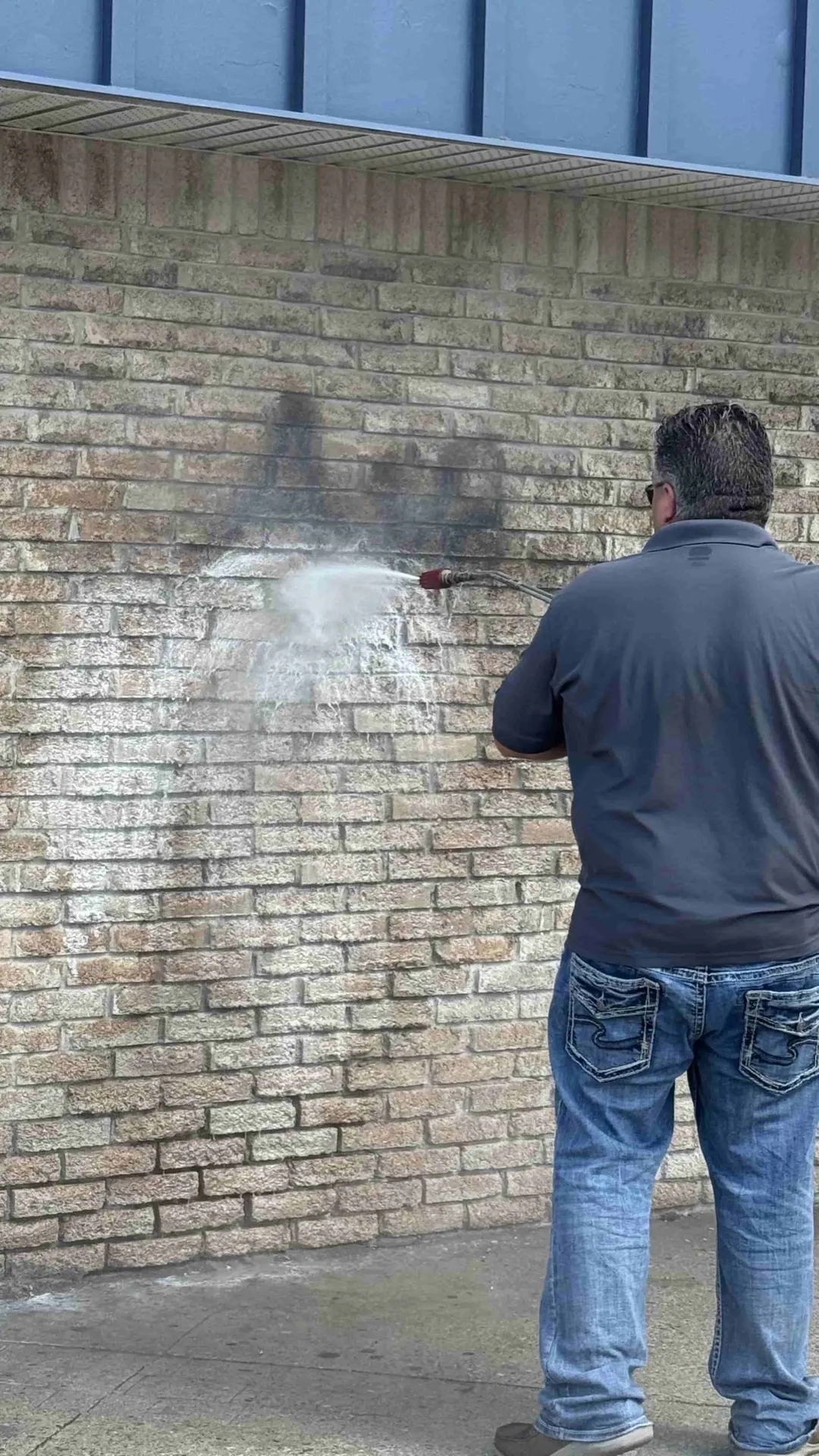
| Brick | No more than about 1,500 PSI, and less on old brick | 40 degrees from a distance | Eroded mortar, chipped faces |
| Cedar, pine and spruce | Roughly 500 to 1,200 PSI, lower for cedar | 40 degrees | Fuzzed fibres, gouges, grain ridges |
| Composite decking | Whatever the manufacturer allows, which can be very little | Widest fan | Scuffed texture, a voided warranty |
| Vinyl siding | As low as still lifts the dirt; a gentler wash is usually better | 40 degrees, sprayed level or downward | Water driven behind the laps |
| Asphalt | Avoid high pressure | Widest tip, with cleaner and a brush | Binder loosened, stones lifting |
Two notes on the table. Sealed or stained concrete and interlock need less pressure, because a hard jet can strip the coating along with the dirt. And the same slab can take more pressure through a surface cleaner than from a hand wand, because the cleaner spins the jet and holds it at one fixed height, so no single spot gets hit for long.
Driveway or patio seen better days?
We pressure wash driveways, patios, decks and walkways across Kitchener, Waterloo, Cambridge & Guelph. Free, no-obligation quotes, ready within 1 business day.
The tip-and-distance routine
- Fit the widest tip you own, normally the 40-degree one.
- Stand so the tip is about 60 cm (24 in) from the surface. That is farther than feels natural.
- Choose a hidden test patch and pass over it at a steady pace.
- If the dirt is not lifting, step in about 10 cm at a time before you consider a narrower tip.
- Let the patch dry and look at it in daylight. Wet surfaces hide fuzz, etching and stripes.
- Note the distance that worked and hold it. Distance drifts closer as you tire.
Signs the setting is too hot
- Wood that feels furry or shows pale ridges after it dries.
- Concrete with light, straight lines, or a rough, sandy feel where the surface used to be smooth.
- Sand missing from paver joints, or pavers that rock under your foot.
- Water dripping from behind siding laps or window trim.
- Flakes of paint or stain in the run-off.
Southern Ontario adds one more reason for care. Slabs weakened by years of freeze-thaw and road salt lose their surface more easily, so a setting that was fine on a new driveway can be too much on a weathered one.
When the number should be close to zero
Some surfaces are cleaned better with a low-pressure wash and a cleaning mix than with a jet: house siding, stucco, roofs and delicate painted trim. That is the idea behind soft washing. Nozzle geometry matters as much as PSI, and the five pressure washer tips explains what each angle does.
If your machine's lowest setting is still too strong for the job, that is the cue to change method, not to stand farther back and hope.
D&D Home Services lists pressure washing and soft washing from $350 each for typical Kitchener-Waterloo homes, with the final quote in writing before work begins.
Key Takeaways
- PSI is measured at the machine; the tip and your distance decide the force on the surface.
- Treat every range in a chart as a starting point, and let the machine manual and the material maker's care guide override it.
- Test on a hidden patch with the widest tip from about 60 cm, step closer in small increments, and judge the result once it is dry.
- Siding, stucco, roofs and composite decking often call for low pressure or a soft wash instead of a jet.

Request a home-service quote
Select the service you need and describe the work area and access.