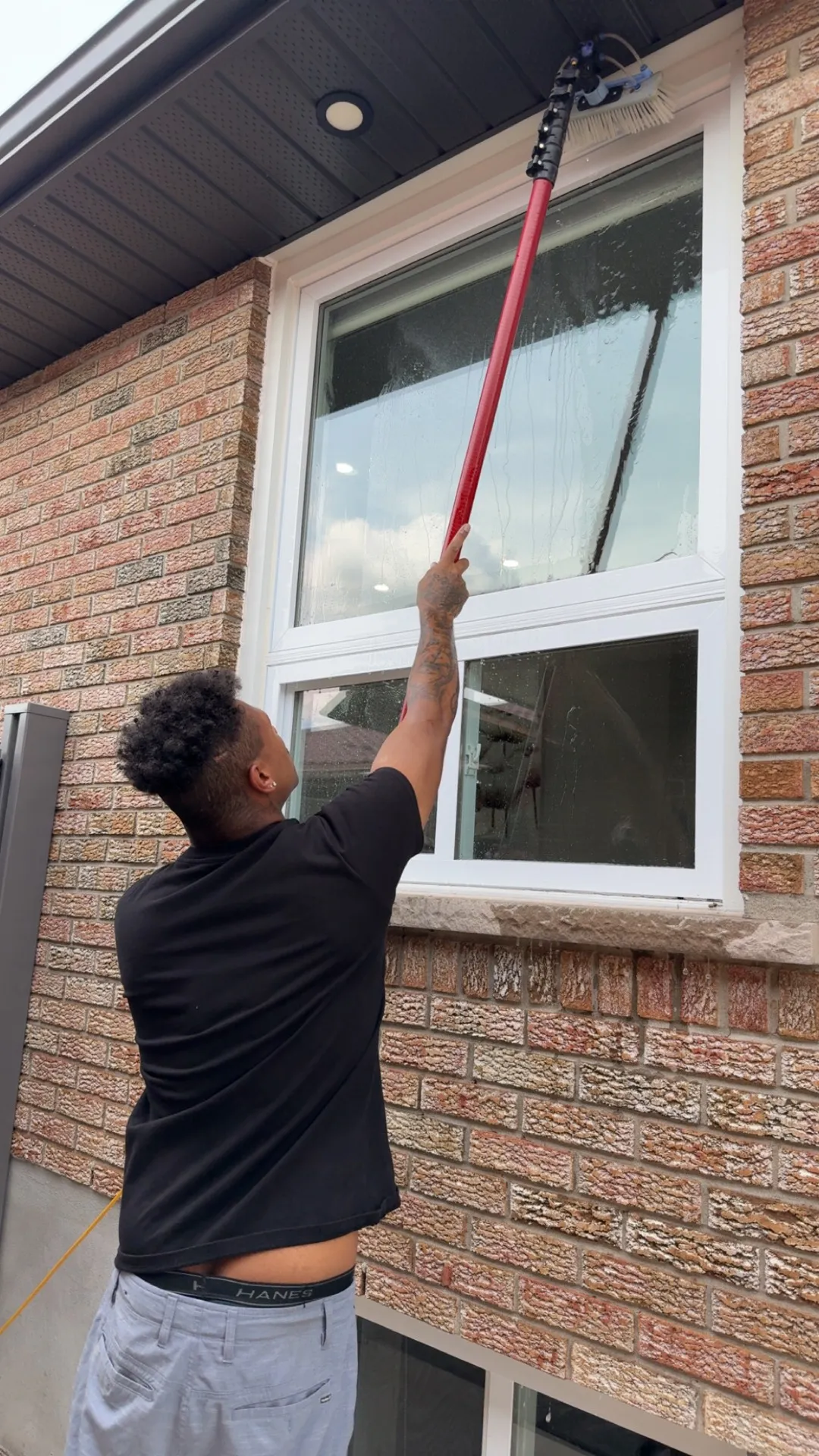
For most homes a vacuum is the lower-risk way to empty an eavestrough, and a pressure washer is the higher-risk one, but each has limits that decide where it belongs. The sections below set out how the two methods work, score them on the hazards that matter and give clear rules for choosing, using and skipping each.
In This Article
The short answer and the reason
A vacuum pulls debris toward you and away from the house. A pressure washer throws it, and the water carrying it, in every direction. That single difference explains most of the safety gap.
Neither one removes the need to look inside the trough. Wet, packed leaf mat is best lifted out by hand first, and a hose flush afterwards proves the water runs. The vacuum and the washer are for what is left.
How each method works
- Wet-dry vacuum. A shop vacuum fitted with a hose, rigid extension tubes and a curved nozzle that reaches into the trough. Some people use it from the ground on a low eave, others carry a light unit up a ladder. Suction lifts dry and damp debris into a canister.
- Pressure washer. A wand or a curved gutter attachment sprays water to loosen debris and drive it out of the run. Long attachments let you spray from the ground, and others need a ladder.
The vacuum collects the mess in one place. The washer spreads it across siding, windows and lawn, and pushes some of it into the downspout.
Gutters overflowing, or overdue for a clean?
We clean and flush gutters across Kitchener, Waterloo, Cambridge & Guelph, and catch small problems before they reach your foundation. Free, no-obligation quotes, ready within 1 business day.
A safety scorecard
| Hazard | Wet-dry vacuum | Pressure washer |
|---|---|---|
| Falls | Lower, since a light unit and pole can work from the ground or a well-set ladder | Higher on a ladder, because the wand pushes back and needs two hands |
| Electrical | A cord at the base of the ladder, near wet ground | A cord or engine, a long wet wand and overhead wires close to the eaves |
| Water behind the trough | None, since suction adds no water | A hard stream can reach the fascia joints, soffit vents and the first row of shingles |
| Damage to the system | Low, apart from scraping with a hard nozzle | Real, including loosened hangers, popped end caps and opened seams |
| Dust and mould | Exposure from dry debris and the exhaust | Splatter of wet muck onto you and the house |
| Mess | Contained in the canister | Slurry on walls, windows and beds |
| Packed wet debris | Clogs the hose and fills the canister fast | Loosens it but pushes it into the downspout elbow |
Using a vacuum safely
- Choose a dry, calm day, and check the ladder, the ground and the overhead lines before setting up.
- If you use a ladder, keep three points of contact and set the base on firm, level ground with a standoff. Working at Heights training in Ontario is meant for workers and is not a homeowner requirement, though its habits transfer well to a ladder at home.
- Plug into a ground-fault protected outdoor outlet with an outdoor-rated cord, and keep the cord clear of the ladder base and of wet ground.
- Wear a dust mask, eye protection and cut-resistant gloves.
- Scoop the wet mat out by hand into a bucket first, and vacuum only the loose remainder.
- Work in short sections, and empty the canister before it gets too heavy to handle.
- Keep the pole and hose well away from power lines, and never lean sideways to reach further.
- Finish with a hose flush at ordinary flow, and check that each downspout runs.
The Electrical Safety Authority advises ground fault protection and outdoor-rated cords, and says to keep ladders and tools at least 3 metres from overhead powerlines.
Where pressure washing still fits
Use a pressure washer on the outside faces and downspouts, not on the inside of the trough. Dark stripes and dirt film come off with a mild cleaner, a soft brush and a low-pressure rinse, ideally from the ground and never aimed up under the roof edge. If a gutter wand attachment is all you have, treat it as a last resort, keep the pressure at its lowest setting and be ready to stop if you see water at the fascia or a hanger moving.
Choose a vacuum if, choose a crew if
Choose the vacuum if the debris is dry or damp, the eave is low and you can work from the ground or a well-set ladder.
Choose pressure washing only if the goal is to clean the outside faces, at low pressure, from the ground.
Choose a crew if the eave is at second-storey height, wires or ice are present, the fascia looks soft or you would be working alone. Crew members at D&D hold Working at Heights certification, and its gutter cleaning starts from $125 for a typical Kitchener-Waterloo home, quoted free and in writing before work begins. Read ladder safety for exterior home maintenance, the guide to tools for DIY gutter cleaning and gutter cleaning safety for two-storey homes before you climb.
Key Takeaways
- A vacuum pulls debris out and contains it, while a pressure washer throws debris and water around, which is why the vacuum is generally the lower-risk method.
- Pressure washing a trough adds recoil, electrical exposure, water behind the fascia and possible damage to seams, hangers and end caps.
- Scoop wet, packed debris by hand first, vacuum what is left, and finish with a hose flush to prove the downspouts run.
- Use a pressure washer only on outside faces at low pressure from the ground, and hand second-storey eaves, wires or ice to a crew.
Sources & References

Request a home-service quote
Select the service you need and describe the work area and access.