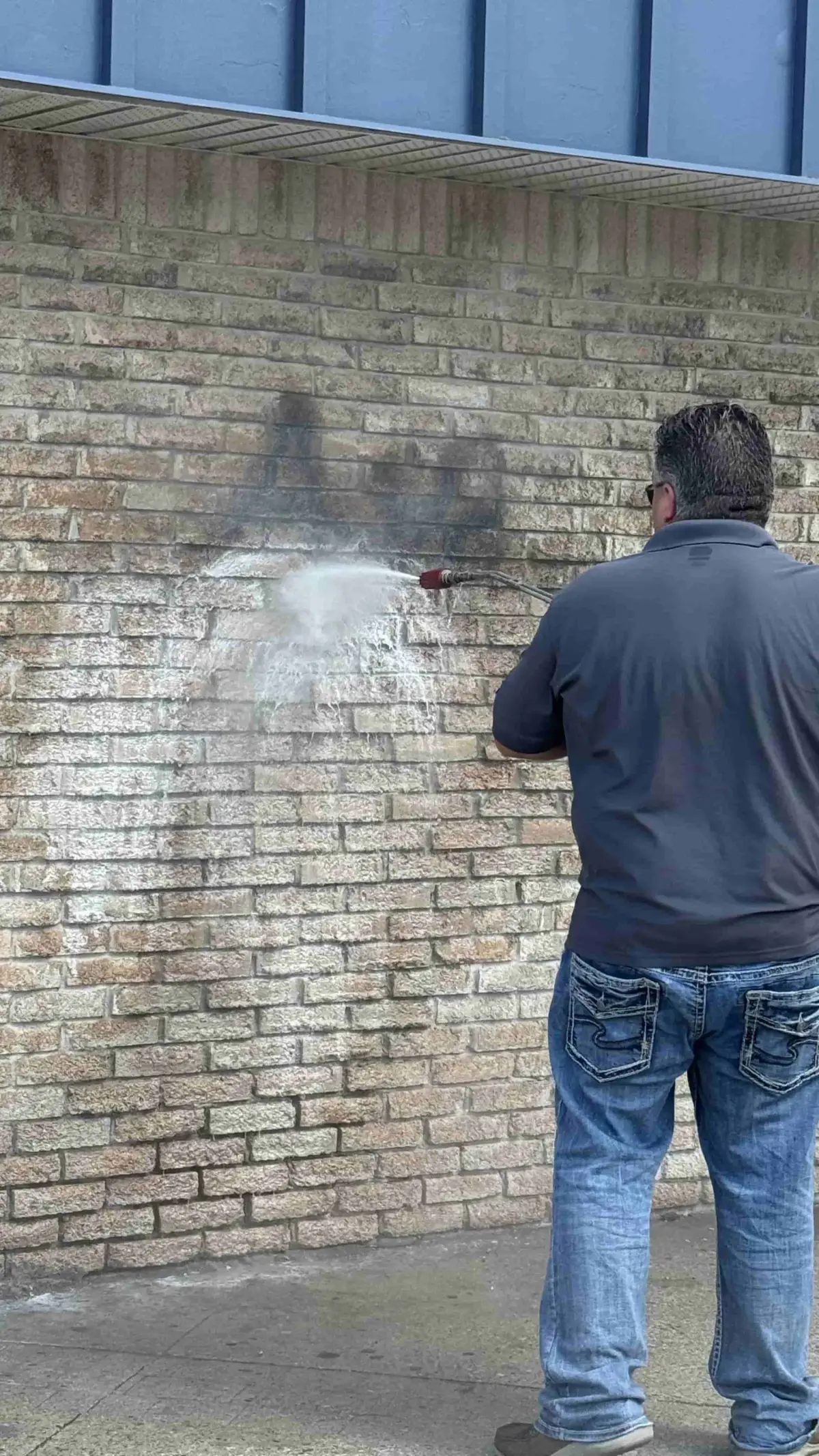
A weathered, grey wood fence can be transformed with a thorough pressure washing and fresh stain, but pressure washing wood incorrectly causes more damage than leaving it dirty. Raised grain, furring, scarring from aggressive tips: these are the marks of a pressure washing job gone wrong. Here's how to clean a wood fence effectively without leaving it worse than you found it.
In This Article
Wood Fence Damage Risks from Pressure Washing
Wood is a living material with a grain structure, fibres running along the length of the board. High-pressure water directed across or into the grain physically lifts and separates these fibres, creating a raised, fuzzy, rough texture called grain raising or "fuzzing." Once the wood grain has been raised, it must be sanded before staining, otherwise stain application looks uneven and the texture is permanently altered.
If you would rather leave the fence to a crew, see our page on pressure washing in Kitchener-Waterloo (from $350).
The risk factors for fence damage:
- PSI too high: Above 1,500 PSI on most softwoods, grain raising becomes likely. Cedar and pine are particularly soft. Hardwood species (oak, ipe) tolerate somewhat higher pressure.
- Wrong nozzle angle: The 0° and 15° tips concentrate force into a narrow stream that can visibly scar wood, cutting into the surface along the grain or across it.
- Spraying across the grain: Moving the wand perpendicular to the wood grain direction is significantly more damaging than moving it parallel. Pressure that cuts across wood fibres lifts and separates them.
- Too close to the surface: At under 6 inches, even appropriate PSI becomes too concentrated on a small area.
- Soft or weathered wood: Older fence boards that have been exposed to Ontario winters without sealing for many years may be partially degraded at the surface, these boards need even lower pressure.
Pro Tip: Before washing the whole fence, test a hidden section (the back of a post or a low corner board) at your intended pressure settings. Look for fuzzing or grain change. This takes 5 minutes and can save an entire fence from damage.
Correct PSI for Wood Fences
The recommended pressure for wood fences is significantly lower than for concrete:
| Wood Type | Recommended PSI | Notes |
|---|---|---|
| Cedar (most Ontario fences) | 1,000–1,200 PSI | Very soft; start conservatively |
| Pine / SPF lumber | 1,000–1,200 PSI | Soft; similar to cedar treatment |
| Pressure-treated pine | 1,200–1,500 PSI | Slightly denser than standard pine |
| Douglas fir | 1,200–1,500 PSI | Moderately hard |
| Hardwoods (oak, ipe, teak) | 1,500–2,000 PSI | Dense grain tolerates more pressure |
| Weathered/aged wood (any species) | 800–1,000 PSI | Surface degradation reduces density |
The vast majority of wood fences in Kitchener-Waterloo are cedar or pressure-treated pine. Both are soft species, treat them conservatively at 1,000–1,200 PSI. If your fence is in good structural condition but hasn't been maintained (grey, grimy, but boards are sound), this PSI range combined with proper technique will clean effectively without grain damage.
Driveway or patio seen better days?
We pressure wash driveways, patios, decks and walkways across Kitchener, Waterloo, Cambridge & Guelph. Free, no-obligation quotes, ready within 1 business day.
Nozzle Selection for Wood Fence Cleaning
For wood fences, the nozzle choice is straightforward:
- 40° white tip: The safest choice for standard fence boards. Wide fan, lower force concentration. Use this for initial cleaning passes and for aged or soft wood.
- 25° green tip: Acceptable for harder fence materials or for stubborn mould staining. Use with the wand held at 12–18 inches from the surface.
- Never use 0° or 15° tips on wood. These create concentrated streams that scar, etch, and furrow wood surfaces, the damage is permanent without sanding.
- Never use a rotating turbo nozzle on wood. The spinning jet concentrates force in a spiral pattern that consistently damages wood grain.
Many homeowners rent a pressure washer and grab the most aggressive nozzle thinking it will clean faster. On concrete, this works. On wood, it creates permanent scarring. The 40° tip takes slightly longer but leaves the fence ready for staining rather than requiring emergency sanding.
Spray Technique for Wood Fences
Proper technique for wood fence cleaning:
Always spray with the grain. This is the paramount rule. Move the wand parallel to the wood fibres, along the length of each board, not across it. For vertical fence boards (common privacy fence style), move the wand up and down. For horizontal rails, move it side to side along the rail length. Crossing the grain at any point risks lifting fibres.
Work in sections: Clean individual boards or groups of boards completely before moving to adjacent sections. This ensures consistent pressure and allows you to check the result on each board before moving on.
Maintain consistent distance: Hold the nozzle 12–18 inches from the fence surface. Closer concentrates too much force; farther loses cleaning effectiveness. Maintain this distance consistently across the entire board, varying distance creates uneven cleaning and different grain effects.
Overlapping passes: Each wand pass should overlap the previous by about 30–50% to ensure even cleaning. Gaps between passes leave dirty stripes.
Don't forget the top rail and posts: The horizontal rails at the top of fence panels and the fence posts are often the most weathered and mould-covered sections. Give them extra attention, but be careful on the end grain of posts, end grain absorbs water and pressure more readily than face grain.
Low angle at the base: Where fence boards meet the ground, direct the spray at a downward angle to clean the lower portion without spraying into soil and creating muddy blowback that re-coats the boards you've cleaned.
"We always tell homeowners: a wood fence is not a concrete driveway. Lower your pressure, use your widest tip, and move with the grain. Patience pays off with wood, you'll have a fence that's ready to stain, not one that needs sanding first."
- Devon, D&D Home Services Founder
Cleaning Solutions for Wood Fences
For wood fences, cleaning solutions add significant value, particularly for biological growth and the greying caused by UV degradation:
Oxygen bleach deck/fence cleaner: Choose a product labelled for the actual wood and finish, and follow its dilution, contact time and rinse instructions. Do not assume an oxygen-bleach ingredient makes the complete cleaner harmless to vegetation or proves every mould-killing claim. Health Canada advises reading and following product handling instructions.
Wood brightener: Choose a brightener only where the wood, existing finish and coating system permit it. Follow its contact time and rinse instructions rather than a fixed five-to-ten-minute dwell; keep it separate from bleach and other cleaning chemicals.
Dilute bleach solution: For heavily mould-infested fences, a soft washing approach, using a product labelled for the actual wood, finish and staining, requires its specified dilution, dwell and rinse method. Do not assume a fixed bleach percentage or pressure rinse is suitable. Protect vegetation as directed.
Avoid:
- Chlorine bleach at full concentration, it damages wood fibres with repeated use
- TSP (trisodium phosphate), banned in Ontario for environmental reasons; TSP substitutes are available and acceptable
- Petroleum-based solvents, these stain and can be difficult to fully remove before staining
Drying Time Before Staining
After cleaning, follow the selected stain or sealer’s moisture and preparation requirements. The requirements differ by product, so neither a fixed waiting period nor a generic moisture-meter threshold establishes readiness for every coating.
Drying time: DEFY Extreme Semi-Transparent Wood Stain permits same-day staining after cleaning and brightening once the wood is visibly dry, but not while wet or saturated. Follow the exact product’s temperature and rain-free requirements. Other coatings can require different conditions.
How to test readiness: Use the checks specified by the chosen coating. DEFY Extreme uses a water-absorption check after drying; poor absorption may mean moisture or insufficient porosity. It is not a universal moisture measurement. Use a moisture meter and threshold only as the coating instructions require.
- Use a water-absorption test if the selected stain calls for it. Passing that check alone does not establish that all surface preparation, moisture and weather requirements have been met.
- Touch the wood, it should feel dry, not cool and slightly damp.
- If the chosen coating specifies a moisture-meter check, follow the meter instructions and compare the reading with that coating’s stated limit. Do not treat 19% as a universal staining threshold.
Composite vs. Wood: Important Differences
Not all fences are solid wood. In Kitchener-Waterloo, composite fencing (products like Trex, TimberTech, or generic composite lumber) has become increasingly common. The cleaning approach differs significantly:
Composite fence cleaning:
- Lower PSI is appropriate, typically 1,200–1,500 PSI maximum
- 40° tip only, composite surfaces can show pressure marks from narrower tips
- Always check the manufacturer's cleaning guidelines, some composites have specific requirements
- No staining is needed or appropriate, composite products are pre-coloured and sealed from the factory
- Oxygen bleach cleaners work well for biological growth on composite
- Avoid abrasive cleaners that scratch the surface coating
Chain link fence cleaning: Completely different situation, chain link handles any reasonable PSI. Use 2,000–2,500 PSI to clean accumulated grime and algae from the metal links and poles. The concern here is directing spray away from yourself (blowback) rather than surface damage.
Metal picket fence: Cast iron and aluminium decorative fences clean well at 1,500–2,000 PSI. After pressure washing, immediately dry with a cloth or allow full drying in the sun, metal will rust or show water spots if left wet for extended periods. Apply a rust-inhibiting primer and paint on any areas where paint has been removed.
For fence cleaning combined with complete exterior cleaning packages throughout Kitchener, Waterloo, Cambridge, and Guelph, our pressure washing team handles fences as part of our residential cleaning services.
Key Takeaways
- ✓ Maximum 1,000–1,200 PSI for cedar and pine fences - the most common fence materials in Ontario
- ✓ Use a 40° tip only on wood - the 0° and 15° tips cause permanent scarring
- ✓ Always spray with the grain, never across it, crossing grain raises and damages wood fibres
- ✓ Use cleaners and any brightener permitted for the actual wood, finish and coating system; follow their separate handling and rinse instructions.
- ✓ Follow the selected coating’s moisture, temperature and rain-free requirements before staining; a fixed 48–72-hour wait is not universal.
- ✓ Composite fences don't need staining - lower PSI, factory-coloured, check manufacturer guidelines

Pressure washing quote (from $350)
Tell us the surface, such as driveway, patio, deck or walkway, and its rough size.