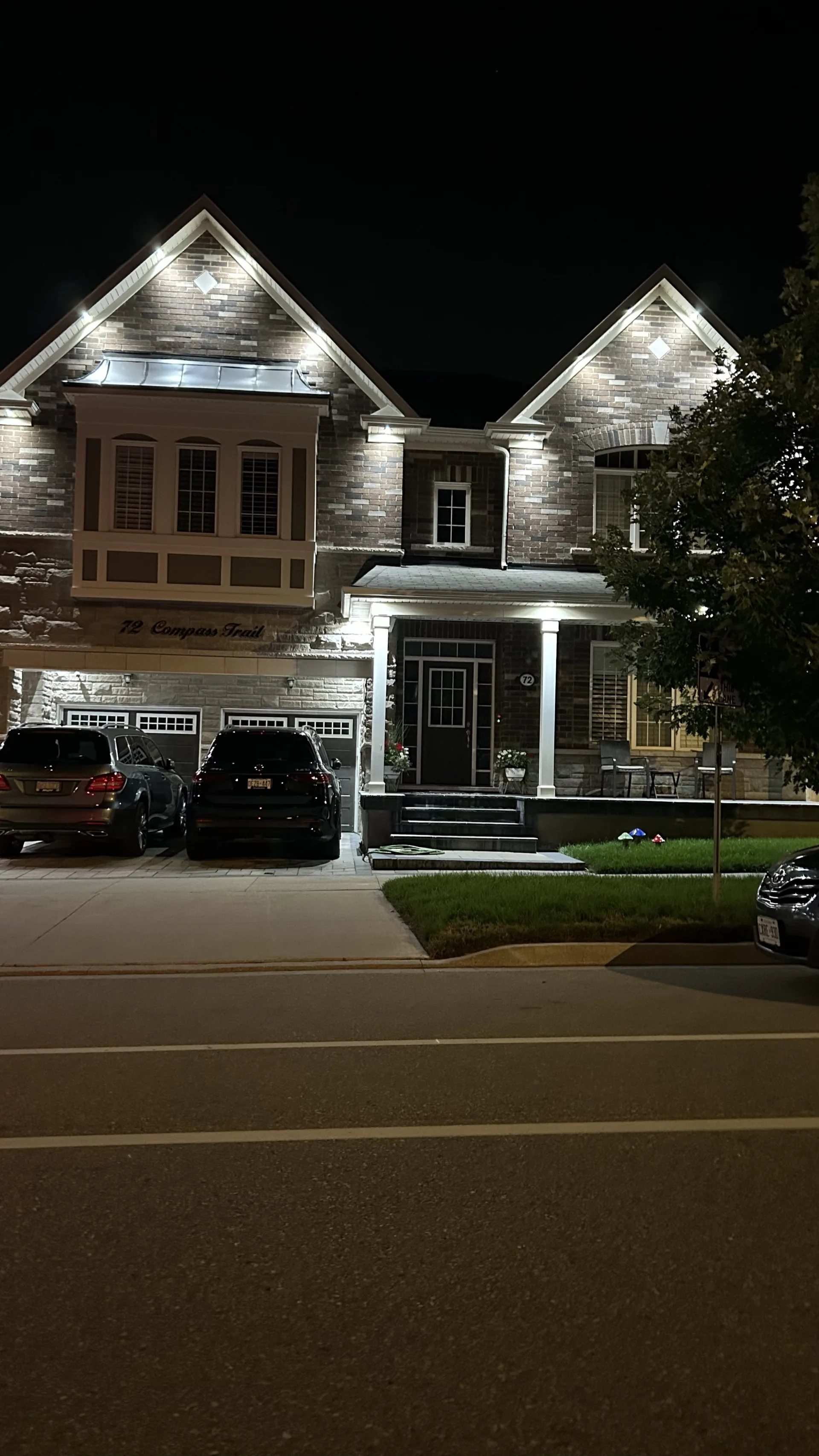
To hang Christmas lights on a house, measure the roofline, test every string, choose clips made for each surface and fasten them from a level, well-set ladder. Never use staples or nails. Plug into a GFCI-protected outdoor outlet and stay 3 metres from power lines. Ontario adds frosty ladders and stiff cords, so this guide covers the steps, the right clips and when a crew should do it.
In This Article
- Step 1: Plan the display and measure the roofline
- Step 2: Pick the right clip for each surface
- Step 3: Set up the ladder and work safely
- Step 4: Hang the lights and connect the power
- How to hang Christmas lights on a house with gutter guards or without gutters
- When a two-storey front is a job for a crew
- Questions about hanging Christmas lights
Step 1: Plan the display and measure the roofline
Decide where the lights will go before you buy anything. A single run along the eavestrough is the simplest. Gables, peaks, windows and a porch add length and more places to climb.
- Measure each run in metres. Walk the foundation with a tape or a length of string to estimate the eave, and add extra for corners, drops and the cord back to the outlet.
- Match strings to runs. Divide each run by the string length, and check the bulb spacing so the ends land where you want them.
- Check the power. Note where each plug will connect, and what the label says about how many strings can join.
- Test every string on the ground. Replace dead bulbs now, not on a ladder.
- Buy extra clips. Plan on one at each bulb or socket for a straight line, or at the spacing the clip maker suggests.
Want an exact price for your home?
Skip the guesswork: we look at your actual property and quote it in writing, free and no-obligation. Serving Kitchener, Waterloo, Cambridge & Guelph.
Step 2: Pick the right clip for each surface
| Surface | What to use | What to watch |
|---|---|---|
| Eavestrough or gutter lip | Gutter clips that hook over the front lip | Do not hang from a trough that sags or has loose hangers |
| Fascia board | Fascia or all-purpose clips made for the board | Adhesive hooks hold poorly on cold, damp or dusty wood |
| Asphalt shingle edge | Shingle clips that slide under the tab | Cold shingles turn brittle, so do not force a tab up |
| Siding | Siding clips that hook under the lap | Check the clip suits vinyl, aluminum or wood |
| Brick or stucco | Clips made for masonry | Do not drill unless you are sure of the wall |
| Soffit or thin trim | Light clips made for it, or hang from the fascia | Thin panels dent and are not made to carry weight |
Never use staples, nails or tacks. They can pierce the cord, and the Electrical Safety Authority advises proper clips instead. Holes through shingles also let water in. Tape peels off in the cold and leaves residue. If you are unsure what fastening can do to your trim, read whether lights can damage eavestroughs and fascia.
Step 3: Set up the ladder and work safely
The ladder is where most of the risk is. The Canadian Centre for Occupational Health and Safety advises these rules, and they suit homeowners as well as workers:
- Set the ladder on firm, level ground with slip-resistant feet.
- Use the 4 to 1 angle: the base sits 0.3 metres out for every 1.2 metres of height.
- Keep three points of contact, two hands and a foot or two feet and a hand.
- Do not work from the top three rungs, and do not carry lights in your hands. Use a tool belt or a hoist bag.
- Do not use a ladder on ice, mud or other slippery surfaces.
The ESA says to stay at least 3 metres from overhead power lines. Check before you set up, because the wire from the street meets the house somewhere along the roofline.
Ontario adds its own problems in November. Frost can sit on the ground and rungs well into the morning. Wet leaves hide slippery spots, and cold hands lose their grip fast. Wait for the frost to melt, move the ladder instead of reaching, and have someone steady it. Our ladder safety guide for exterior work has a longer checklist.
Step 4: Hang the lights and connect the power
Start at the end nearest the outlet so the plug stays close to the power. Clip as you go, and move the ladder rather than leaning out.
- Lay out the string and keep the cord straight, with the bulbs facing the way you want them.
- Clip at each bulb or socket. Leave a little slack, because cords stiffen and contract in the cold, and a taut string can pull clips loose.
- At each plug connection, let the cord hang in a small loop below the join so rain runs off it and does not run into it.
- Keep connections off the ground and away from puddles, driveways and walkways, as the ESA advises.
- Connect only as many strings as the label allows. The ESA's general advice is no more than three together, and any extra length should have its own feed.
- Plug into a GFCI-protected outdoor outlet, press the test button on the GFCI, then switch the lights on and check every run.
Use outdoor-rated extension cords and timers. Do not run a cord through a closed door or window. If you have no outdoor outlet, adding one is electrical work for a Licensed Electrical Contractor under ESA rules.
How to hang Christmas lights on a house with gutter guards or without gutters
With gutter guards. What works depends on the guard. Some leave the front lip of the trough exposed, so ordinary gutter clips still fit. Others cover the lip, or sit on top of it, and a clip may pry the guard up or bend its edge. If the guard blocks your clips, use fascia clips on the board below, or ask the guard maker which clips suit it. Do not drill through a guard or force a clip under it.
Without gutters. A roof edge with no trough leaves three options. Fascia clips attach to the board. Shingle clips slide under the lower tab on a mild day. And lighting at ground level, such as stakes along the beds, avoids the roof entirely.
In both cases, keep the weight light and the fastening gentle, and look at what you are clipping to first. Cracked fascia or a loose trough is a job to fix before it carries lights.
When a two-storey front is a job for a crew
Hire a crew if the work needs a ladder that reaches past a single-storey eave, if the roof is steep or the ground slopes, if wires are close, or if the display is large. Peaks and gables are the hardest places to light safely, and a fall from a second-storey ladder is serious.
D&D Home Services offers holiday lighting for homes across Kitchener-Waterloo, with installation, takedown and storage from $750 for typical homes, and crews trained to work at heights. Details are on our holiday lighting page. For what shapes a quote, read about Christmas light installation costs in Ontario.
When the season ends, take the lights down on a dry, mild day. Unclip them rather than pulling, and wind each string onto a reel or a piece of cardboard so the cord is not kinked in storage.
Questions about hanging Christmas lights
What should I use to hang Christmas lights on a house?
Use clips made for the surface: gutter clips for the eavestrough lip, shingle clips for the roof edge, siding clips for lap siding and fascia clips for trim. Do not use staples, nails or tape. Staples and nails can damage the cord, and nail holes through shingles can let water in.
Can you hang Christmas lights on gutter guards?
Sometimes. It depends on the guard. If the front lip of the trough is exposed, standard gutter clips may fit. If the guard covers or sits over it, a clip can bend or lift the guard. Use fascia clips below it, or ask the guard maker which clips are suitable, and never drill through the guard.
How do you hang Christmas lights on a house without gutters?
Use fascia clips on the board, or shingle clips that slide under the lower edge of the shingle tab on a mild day. Cold shingles can crack, so do not force a tab up. If the edge will not take a clip safely, light the house from ground level with stakes along the beds or a few well-placed floodlights.
Do I need a GFCI outlet for outdoor Christmas lights?
The Electrical Safety Authority advises using ground fault circuit interrupters for outdoor connections. Plug into a GFCI-protected outlet, and press its test button before you hang the lights. If you have no outdoor outlet, adding one is work for a Licensed Electrical Contractor.
Key Takeaways
- Measure each run, test every string and buy clips made for each surface, never staples or nails.
- Set the ladder at 4 to 1 on firm, level ground, keep three points of contact and stay 3 metres from power lines.
- Wait for frost to clear in November, move the ladder instead of reaching and unroll stiff cords before use.
- Plug into a GFCI-protected outlet, keep connections off the ground and stay within the string limits on the label.
- Two-storey fronts, steep roofs and large displays are jobs for a trained crew.
Sources & References

Request a home-service quote
Select the service you need and describe the work area and access.