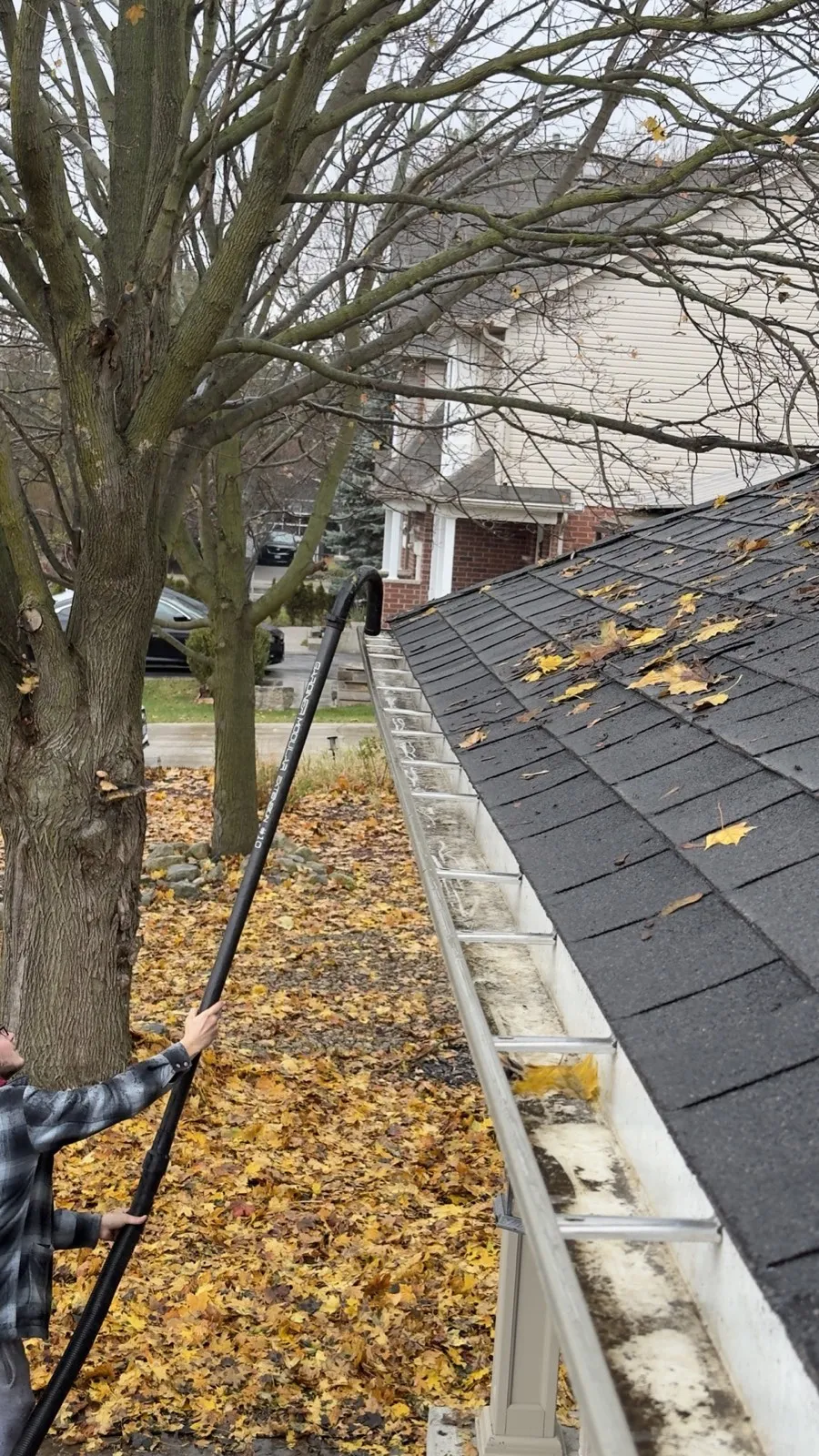
To clean your own gutters, set a ladder safely at a single-storey eave, scoop the debris into a bucket, flush the trough and downspout with a hose, and check that water drains. Pick a dry day in late October or November, after most leaves have dropped and before freeze-up. A two-storey roofline, a steep roof or no level ground means calling a crew instead.
In This Article
- Before you clean your own gutters: timing, weather and gear
- Step 1: Set up the ladder
- Step 2: Scoop out the debris
- Step 3: Flush the trough and the downspout
- Step 4: Check pitch, joints and hangers while you are up there
- Step 5: Get rid of the debris properly
- When a two-storey roofline means calling a crew
- DIY gutter cleaning questions
Before you clean your own gutters: timing, weather and gear
In Kitchener-Waterloo, Cambridge and Guelph, the main job comes after most maple leaves are down in late October and into November. Oaks hold their leaves longer, so a second look in early winter is common. Spring brings seed pods and winter debris that also need clearing. The trick is to catch a dry day above freezing between the leaf drop and the first hard frost.
Wait for a day with no rain, no wind and no frost on the ground. Wet muck is heavy and the ladder is less safe on wet or frozen footing.
Gather these first:
- A sturdy ladder in good condition, with a stand-off or stabilizer if you have one.
- Waterproof gloves and eye protection. A dust mask helps with mouldy debris.
- A plastic scoop or a small garden trowel. Metal can scratch the finish.
- A bucket with a hook, or a tarp below the work area.
- A garden hose with a spray nozzle.
Our guide to tools for DIY gutter cleaning covers the options in more detail.
Want an exact price for your home?
Skip the guesswork: we look at your actual property and quote it in writing, free and no-obligation. Serving Kitchener, Waterloo, Cambridge & Guelph.
Step 1: Set up the ladder
Look up first. Stay at least 3 metres from overhead power lines, as the Electrical Safety Authority advises. If a service wire is near the eave, stop and call a pro.
Then set the ladder up the way the Canadian Centre for Occupational Health and Safety recommends:
- Firm, level ground with slip-resistant feet. Not wet grass, ice or mud.
- The 4 to 1 angle: the base sits 0.3 metres out for every 1.2 metres of height.
- Three points of contact at all times. Do not work from the top three rungs.
- No tools or buckets in your hands. Hang the bucket from a hook or use a tool belt.
Do not lean the ladder on the trough, which can crush or bend it. Move the ladder when you can no longer reach comfortably, rather than leaning out. Our safety checklist for DIY gutter cleaning covers it step by step.
Step 2: Scoop out the debris
Start near the downspout outlet and work away from it, so you are not pushing debris toward the opening. Pull the material toward you with the scoop and drop it into the bucket or onto the tarp.
- Clear the area around the outlet first, so water has a way out.
- Scoop a short length, then move along the run. Wet leaves and muck pack tightly.
- Fill the bucket only part way. Wet debris is heavier than it looks, and a full bucket on a hook pulls on the ladder.
- Look for seedlings, moss and the gritty layer from asphalt shingles. A little grit is normal. A lot may mean the roof is wearing.
Leave a clean, dry trough behind you as you go. Skipping the last bit of fine sludge is how a trough that looks clean ends up holding water.
Step 3: Flush the trough and the downspout
Once the bulk is out, rinse. Start at the end farthest from the downspout and run the hose toward the outlet, so water carries the last of the grit along the trough. Use a normal garden spray. A pressure washer can force joints apart and drive water behind the trough.
Watch the downspout. Water should flow out the bottom steadily. If it backs up, clear the clog from the top with a stream of water or a plumber's snake, and tap along the pipe to find where it is lodged. Elbows are the usual trouble spot. Our guides on flushing downspouts and clearing a blocked elbow show the steps.
Check where the water goes. It should leave the pipe and carry away from the foundation, onto the lawn or into an extension. The Region of Waterloo says stormwater discharge, including rain, must not be connected to the sanitary sewer, so check how an underground drain is connected if you are unsure.
Step 4: Check pitch, joints and hangers while you are up there
The hose doubles as a test. With the trough clean, run water in at the high end and watch.
- Pitch. Water should travel steadily toward the downspout. A trough needs only a gentle fall, commonly about 6 mm over 3 metres. Standing puddles after you stop the hose mean a low spot. See how to check slope and pitch without a professional.
- Seams and end caps. Look for drips at joints and corners. Mark any with tape, and fix them on a dry day.
- Hangers. Wiggle the trough lightly. A run that moves a lot, or pulls away from the fascia, needs repair.
- Fascia. Press a screwdriver tip into the board behind. It should feel firm, not soft.
Problems you find here are easier to fix in fall than after the first freeze.
Step 5: Get rid of the debris properly
Mostly leaves, gutter debris counts as yard waste. In Kitchener, Waterloo and Cambridge, the Region of Waterloo collects it every second week, seasonally from late March to the end of November or early December. Put it in paper yard waste bags or reusable cans without lids. Each bag or can has a weight limit of 23 kilograms (50 pounds), and plastic bags are not accepted. Guelph runs its own program, so check with the city.
Because wet debris is heavy, fill bags part way. You can also compost leaves, or spread a thin layer under shrubs. Do not dump wet muck against the house or leave it where it will wash back toward the downspout.
Finally, put the tarp and the tools away, and look at the ground below the downspouts. Any washed-out spot or pooled water there tells you the discharge needs a longer extension.
When a two-storey roofline means calling a crew
The ladder risk rises quickly with height. Call a professional if:
- The eaves are on a second storey. Our guide to cleaning gutters on a two-storey home explains why.
- The roof is steep, wet or icy, or the ground slopes.
- Overhead wires are close to the eave.
- The troughs are heavy with ice, mould or nests.
- You find sagging, rot or leaking seams that need repair.
- You are not comfortable on a ladder. That is a good reason in itself.
D&D Home Services cleans gutters in Kitchener-Waterloo, Cambridge and Guelph from $125 for typical homes, with crews trained to work at heights and written quotes confirmed before the work. See the gutter cleaning service page for details.
DIY gutter cleaning questions
Can I do gutter cleaning myself?
Yes, if your eaves are at a single storey, you have level ground, a good ladder and no wires nearby. The job takes time and some mess, but the steps are simple. Skip it if your roofline is two storeys, the roof is steep, or you are uneasy at height. Those jobs are safer with a trained crew.
How often should I clean my gutters in Ontario?
Once a year in late fall is the minimum for most homes, after the leaves have dropped. Homes with large maples, oaks or pines overhead often need a second clean in spring, when seed pods and winter debris collect. Check after major storms too, since a clog during heavy rain can overflow quickly.
Can you clean gutters without a ladder?
Partly. Telescoping poles with a gutter wand, or a wet-dry vacuum with extension tubes, can reach a single-storey eave from the ground. You cannot see the whole trough, and packed wet debris can be hard to dislodge. They suit light maintenance, not a heavy clean after leaf drop.
What should I do if the downspout stays clogged?
Run water down from the top and look for where it backs up. Clear elbows and joints first, using a plumber's snake or by taking the elbow apart. If water still will not pass, the blockage may be in an underground drain. At that point it is time to call a professional, not to push harder.
Key Takeaways
- Clean on a dry day above freezing, after most leaves have dropped and before the first hard frost.
- Set the ladder on level ground at a 4 to 1 angle, keep three points of contact and stay 3 metres from power lines.
- Scoop from the downspout end outward, flush the trough with a hose, then test that the downspout runs freely.
- While you are up there, check pitch, seams, hangers and fascia, since problems are cheaper to fix before winter.
- Two-storey eaves, steep roofs, nearby wires or any doubt about heights mean calling a crew.
Sources & References

Request a home-service quote
Select the service you need and describe the work area and access.