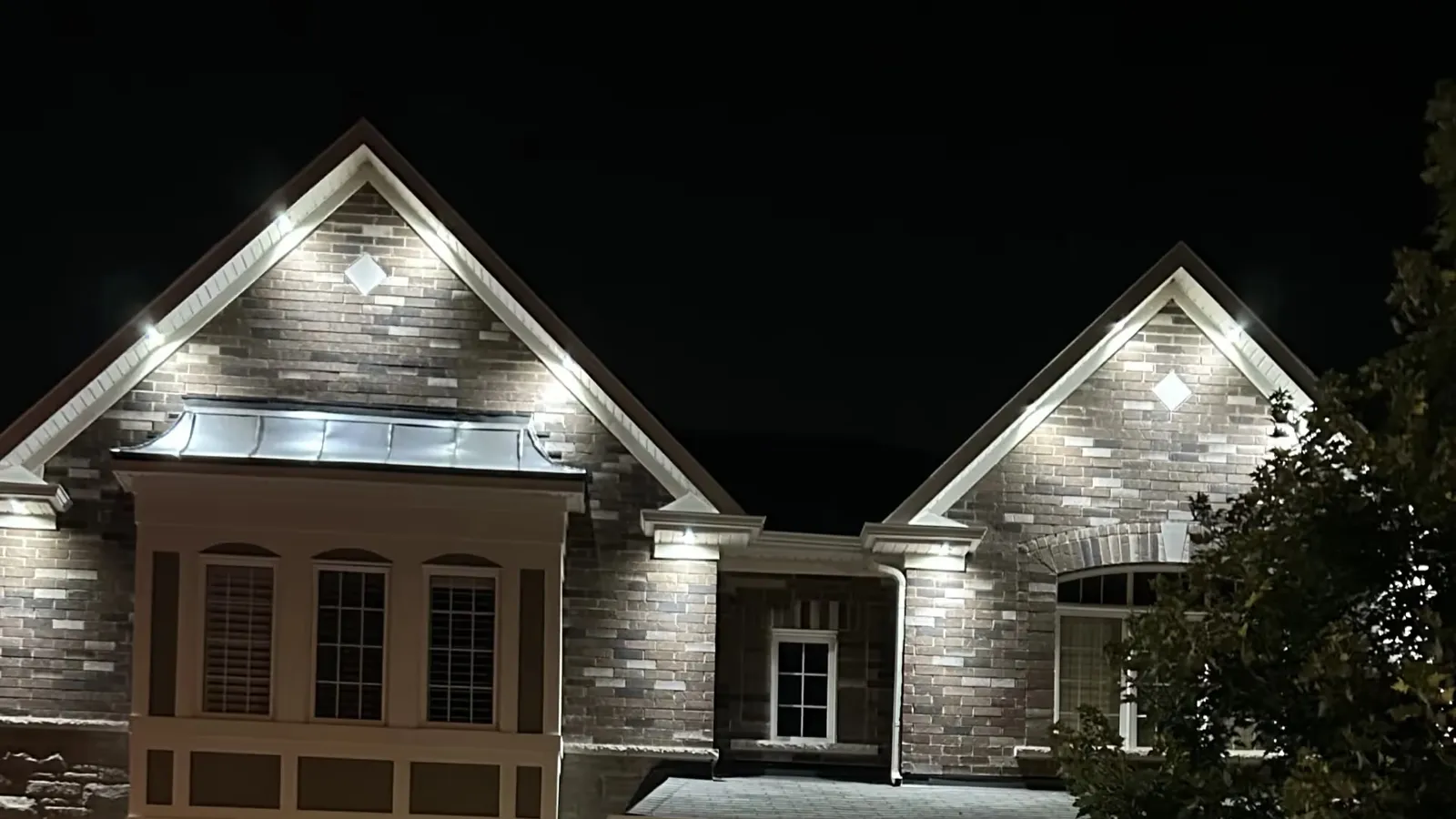
How long do permanent Christmas lights last? The LEDs themselves are usually rated for tens of thousands of hours, which works out to a decade or more at a few hours a night. The whole system lasts only as long as its weakest part, and the parts to watch are the power supply, controller, connectors and seals. Ontario weather, mounting quality and warranty terms decide the rest.
In This Article
- How long do permanent Christmas lights last? Rated hours versus real years
- What fails first on a permanent lighting system
- How Ontario weather affects permanent lights
- Are LED Christmas lights waterproof?
- What a lifetime warranty on permanent Christmas lights covers
- How to help permanent lights last longer
- Permanent lighting lifespan questions homeowners ask
How long do permanent Christmas lights last? Rated hours versus real years
Start with how makers measure life. Natural Resources Canada (NRCan) says good white-light LED products can last at least 25,000 hours, and that their useful life ends when they put out only 70 per cent of their original light. So an LED does not usually die on one night. It fades slowly, and a rated life describes that fade.
To turn hours into years, use this formula: rated hours divided by (hours lit per night times 365). The table runs it for 25,000 hours, the NRCan figure. Your system's own rating may differ, so check its spec sheet.
| Hours lit per night | Hours per year | Years to reach 25,000 hours |
|---|---|---|
| 3 | 1,095 | About 23 |
| 5 | 1,825 | About 14 |
| 8 | 2,920 | About 8.6 |
| 12 | 4,380 | About 5.7 |
The lesson is that your schedule matters. A roofline that glows from dusk until bedtime lasts years longer, on paper, than one that runs until sunrise. Remember too that a rating is not a promise. It describes the LEDs, not the power supply, the controller, the seals or the person who fastened the track.
Want an exact price for your home?
Skip the guesswork: we look at your actual property and quote it in writing, free and no-obligation. Serving Kitchener, Waterloo, Cambridge & Guelph.
What fails first on a permanent lighting system
There is no public failure table for these systems, so treat the list below as places to look, not a ranking. It follows a simple idea: parts with electronics, software or a joint exposed to water have more ways to go wrong than a strip of LEDs or a length of aluminum.
| Part | Why it can wear out | Ask the installer |
|---|---|---|
| Power supply | It turns household power into low voltage, contains electronics, makes some heat and sits outdoors | Where does it mount, is it ventilated, and how is it replaced? |
| Controller and app | Electronics plus software, and app support can change over the years | Who supports the app, and does the schedule run if Wi-Fi drops? |
| Connectors and seals | Joints, cable entries and covers are where water can get in | Are connections sealed, and how are holes in the fascia closed? |
| LED sections | A section can fail or fade faster than its neighbours | Can one section be replaced alone, in a matching colour? |
| Track and cover | Finish and covers can fade, loosen or crack with sun, ice and wind | How is the cover held on, and which finishes are offered? |
Ask which parts the company has replaced most often on past jobs, and what a replacement costs. A straight answer tells you more than a brochure.
How Ontario weather affects permanent lights
The cold itself is the least of it. NRCan lists good performance in cold temperatures as an advantage of LEDs. The wear comes from what winter does to the hardware around them.
- Freeze-thaw cycles. Water that gets into a joint freezes, expands and opens the gap a little more. After many winters, small leaks become real ones.
- Snow and ice at the eave. Snow sliding off a roof can strike a channel at the edge, and ice dams add weight and movement. The guide on permanent lights and eavestroughs or fascia covers the roof edge in detail.
- Summer heat and sun. NRCan notes that LED performance depends on how well they shed heat. A power supply baking in direct sun works harder, and sun also fades finishes and covers.
- Wind. Constant vibration can loosen fasteners and covers over time.
Mounting makes a large difference. A track screwed into sound fascia and sealed at every hole ages better than one fastened into soft wood. The installation guide for permanent LED roofline lighting explains how a careful job goes together.
Are LED Christmas lights waterproof?
Not automatically, and the words on a box can mislead. Weather-resistant means built to cope with rain and snow. Waterproof means built to keep water out even when submerged. Few roofline parts need the second, but they all need the first.
Look for an IP rating, which is a two-digit code. The first digit covers dust and the second covers water. As examples, IP65 means dust-tight and protected against jets of water, and IP67 means dust-tight and able to survive short immersion. Three cautions apply.
- Each part has its own rating, so check the LEDs, connectors, power supply and controller separately.
- A rating describes a lab test, not years of freeze-thaw cycles.
- The Electrical Safety Authority (ESA) says to use lights rated for outdoor use and to choose lights with a recognized Canadian approval mark.
The connection to household power matters as much as the lights. ESA says outdoor outlets should have ground fault circuit interrupters (GFCIs) with weatherproof covers, and that ongoing outdoor power calls for a Licensed Electrical Contractor.
What a lifetime warranty on permanent Christmas lights covers
The word lifetime has no fixed meaning. The contract defines it, and the details decide whether it is worth anything. For scale, NRCan says ENERGY STAR certified LED decorative light strings come with a three-year warranty. That is for seasonal strings, not permanent systems, but it gives you a yardstick, and a longer promise deserves a closer read.
Get the warranty in writing and check these points:
- Whose lifetime. The product's, the original owner's or the house's.
- Which parts. LEDs only, or the power supply, controller and track too. Some parts may carry a shorter term.
- Parts and labour. Does it include a service visit, or only a replacement part you must fit yourself?
- Exclusions. Look for weather damage, ice and snow, power surges, other tradespeople working at the roof edge, fading and app changes.
- Transfer. Does it pass to the next owner if you sell?
- Who stands behind it. The installer, the manufacturer or both, and what happens if one closes.
- Claim process. Who do you call, what proof do you need, and is there a deductible or a fee?
A shorter warranty with full parts and labour can be worth more than a lifetime promise that covers only the LEDs. The guide to whether permanent Christmas lights are worth it shows how to weigh that against the rest of the quote.
How to help permanent lights last longer
- Fix the roof edge first. Sound fascia and straight eavestroughs give the track a firm base.
- Use a proper outlet. A GFCI-protected outdoor outlet near the supply is the clean answer, and a new outlet is electrical work for a Licensed Electrical Contractor, not a lighting crew.
- Keep the power supply clear. Leave it ventilated and out of drifting snow and downspout splash.
- Run it for fewer hours. A dusk-to-bedtime schedule uses up rated hours more slowly than an all-night one. Slightly lower brightness can help too.
- Wash gently. Use a soft brush and low pressure from the ground. Do not aim a jet at joints, covers or cable entries.
- Check each spring. Look for dark sections, flicker, gaps, loose covers and stains. Small faults are easier to fix early.
- Keep records. File the quote, warranty, model numbers and the app account, in your name.
When something does need service, call the installer first. D&D Home Services installs permanent LED roofline lighting for Kitchener-Waterloo homes with a free written quote. It does not do electrical work, so any new outlet or hardwired connection is a separate job.
Permanent lighting lifespan questions homeowners ask
How long do LED Christmas lights last?
Certified LED light strings last far longer than incandescent ones. NRCan says ENERGY STAR certified strings last up to 10 times longer and carry a three-year warranty. In practice a string often gives up at a plug, cord or connection before its LEDs fade, so handle them gently, store them carefully and replace damaged sets.
How long do LED lights last in years?
Divide the rated hours by the hours lit per year. NRCan puts good white-light LED products at 25,000 hours, about 22 years of average household use. A roofline lit five hours a night reaches 25,000 hours in about 14 years. The rating marks when output falls to 70 per cent, not when the lights stop working.
Are LED Christmas lights waterproof?
Not by default. Many are weather-resistant, which is not the same thing. Look for an outdoor rating, a Canadian approval mark and an IP rating for each part, since connectors and power supplies are the usual weak points. Raise connections off the ground and plug them into a GFCI outlet with a weatherproof cover.
Is a lifetime warranty on permanent Christmas lights worth it?
Only if the terms are strong. Check which parts it covers, whether labour is included, what is excluded, whether it transfers when you sell, and who is responsible if the company closes. A shorter warranty with full parts and labour can beat a lifetime promise that covers little.
Key Takeaways
- LEDs are rated for tens of thousands of hours, but a system lasts only as long as its weakest part.
- Divide rated hours by hours lit per year to turn a rating into years. A shorter nightly schedule lasts longer.
- The power supply, controller, connectors and seals are the parts to ask about and to check each spring.
- Weather-resistant is not waterproof. Check each part's IP rating and look for a Canadian approval mark.
- Read what a lifetime warranty covers: which parts, labour, exclusions, transfer and who stands behind it.
Sources & References

Request a home-service quote
Select the service you need and describe the work area and access.