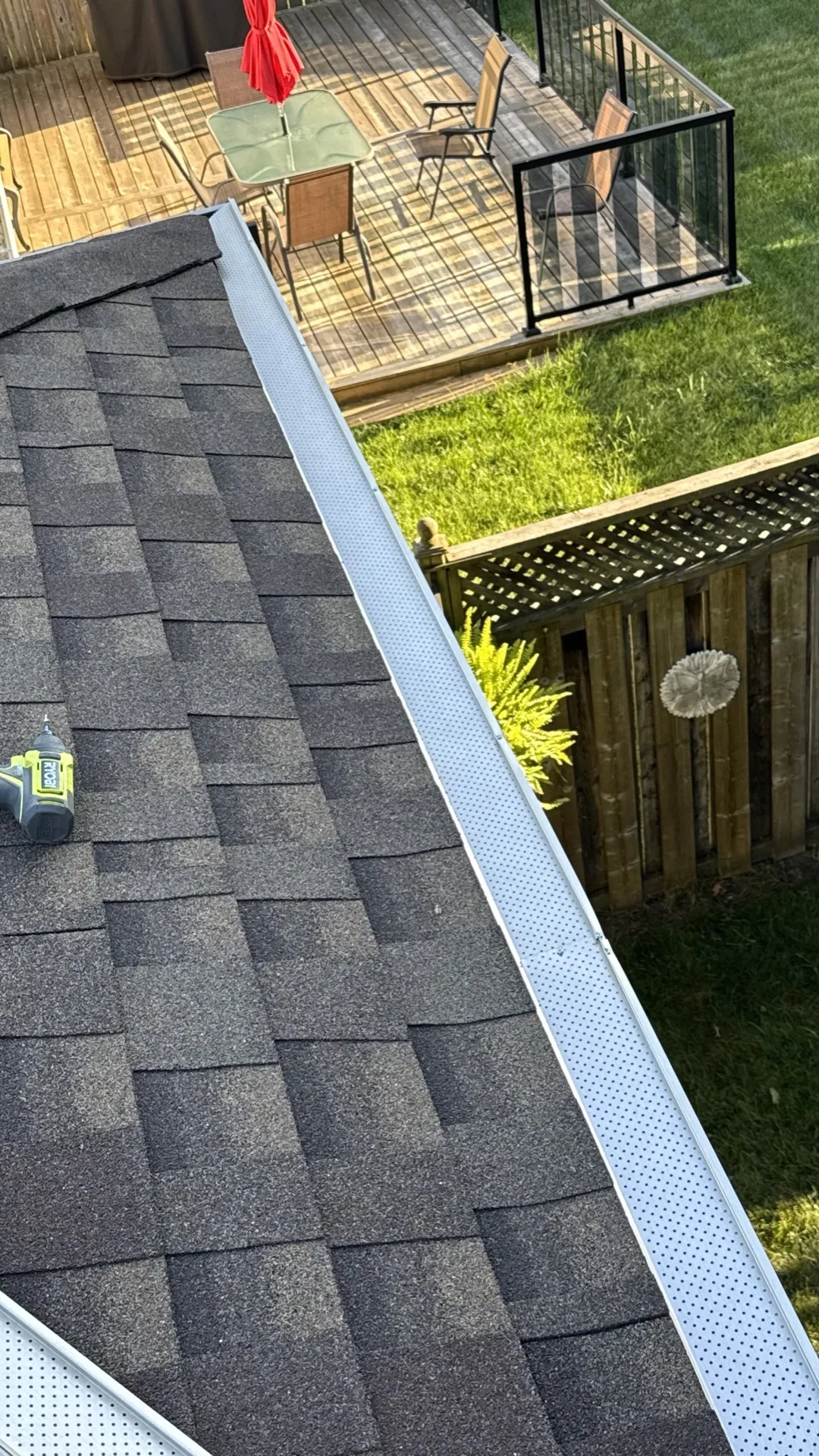
Eavestrough repair covers a short list of jobs: resealing a leaking seam, re-hanging a sagging run, replacing an end cap or downspout, and swapping out one damaged section. Caught early, these are small fixes. Repair stops making sense when the fascia behind the trough is rotten, several seams leak at once, or the metal is worn out. This guide sorts common problems by what actually fixes them and where DIY should stop.
In This Article
- Common eavestrough problems and what usually fixes them
- How the usual eavestrough repairs are done
- Repair or replace: five questions that decide it
- What you can fix yourself, and where DIY stops
- Eavestrough repair in Kitchener, Waterloo and Cambridge: what local conditions add
- When to call a pro, and what an eavestrough repair quote should say
- Eavestrough repair questions homeowners ask
Common eavestrough problems and what usually fixes them
Most eavestrough trouble shows up in one of six ways. Match what you see to the likely cause before you buy parts or book a visit, because the same symptom can have a cheap cause or an expensive one.
| What you see | What it usually means | Usual repair |
|---|---|---|
| Drip or dirty streak at a joint | Sealant has failed at a seam, mitre corner or end cap | Clean, dry and reseal, or replace the end cap |
| Trough sags or dips | Loose or missing hangers, or a load of ice or wet debris | Replace and add hangers, then reset the slope |
| Trough pulls away from the roof edge | Fasteners letting go, often because the fascia is soft | Repair the board first, then refasten |
| Water pools or spills over a clean trough | Wrong slope, an undersized trough or too few downspouts | Re-hang for slope, add an outlet or size up |
| Holes, flaking or heavy corrosion | The metal is worn out, most often steel or very old aluminum | Patch one small spot, or replace the section |
| Downspout loose, crushed or split | Failed straps, an impact or ice inside the pipe | Re-fix the straps or replace the length or elbow |
A hose test narrows it down. Run water into the high end of a cleaned run and watch where it goes. A drip at a joint, a dip that holds water and a downspout that backs up each point to a different repair.
Want an exact price for your home?
Skip the guesswork: we look at your actual property and quote it in writing, free and no-obligation. Serving Kitchener, Waterloo, Cambridge & Guelph.
How the usual eavestrough repairs are done
Seams and end caps. The old sealant is scraped out, the metal is cleaned and dried, and new sealant goes on the inside of the joint, where the water is. A bent or split end cap is replaced rather than patched, usually with rivets and sealant. Our guide to sealing a leaky seam without a pro covers the steps.
Hangers. Hangers carry the whole trough, so a sag usually starts with them. The repair is to replace failed hangers with screw-in hidden hangers that bite into solid wood, add more where gaps are wide, and set the run back to its slope. Closer spacing helps where snow and ice load the front edge. See how loose hangers lead to bigger problems.
Slope. A trough needs a gentle fall toward the downspout, commonly about 6 mm over 3 metres (1/4 inch per 10 feet). Re-pitching means releasing and resetting hangers along the run. It takes a level and patience more than parts.
A damaged section. Where metal is dented through or corroded, the bad length is cut out and a new piece is joined in. On a continuous one-piece run, that adds seams to a run that had none, so a good repair keeps the patch short and seals the joints carefully.
Downspouts. Loose straps are re-fixed, split lengths and elbows replaced, and the outlet pointed well away from the foundation. If yours drains into an underground pipe, note that the Region of Waterloo says stormwater discharge, including rain, must not be connected to the sanitary sewer.
Fascia. The board behind the trough is what every fastener bites into. Press a screwdriver tip into it. Firm wood is fine. Soft or crumbling wood has to be replaced before anything new is fastened to it, and our note on fascia board replacement explains what drives that work.
Repair or replace: five questions that decide it
- Is the problem isolated? One bad seam or one dented section is a repair. Leaks at several joints along a run mean the sealant is ageing everywhere, and you will be chasing drips each season.
- What is behind the trough? Rotten fascia or soft rafter tails mean carpentry first. Since the trough has to come off anyway, that is often the moment to renew that run.
- How old is it, and what is it made of? Aluminum lasts a long time in Ontario, but thin metal that is chalky, pitted or creased in many places has little left. Steel that is rusting through cannot be saved. Vinyl that has turned brittle will crack again.
- Is it the wrong size? A clean trough that still overflows on a large roof may be undersized or short of downspouts. Repairs do not change that.
- Have you fixed this spot before? A repeat failure points to a structural cause, such as slope, hangers or fascia, not to bad luck.
If the repairs you need add up to most of a run, ask for a quote to replace that run as well, and compare the two. Our repair versus replacement guide goes deeper on the trade-off.
What you can fix yourself, and where DIY stops
A careful homeowner can handle small jobs at a single-storey eave: resealing one seam, re-fixing a downspout strap, replacing a downspout length, adding an extension, tightening a hanger screw into solid wood and flushing the run. Those need only ordinary tools and a dry day.
The ladder is the real limit. Set it on firm, level ground at the 4 to 1 angle, which means the base sits 0.3 metres out for every 1.2 metres of height. Keep three points of contact, do not work from the top three rungs, and do not carry tools in your hands. Stay at least 3 metres from overhead power lines. Never lean the ladder on the trough itself.
Leave these to a pro:
- Anything at a second-storey eave or on a steep roof.
- Fascia repairs, which are carpentry as much as eavestrough work.
- Re-pitching a long run, or cutting and joining continuous aluminum, where tight joints depend on technique.
- Soldered copper joints.
- Any trough with ice in it or frost on the ladder footing.
Sealant has a minimum application temperature printed on the label, so schedule DIY seam work for a dry, mild spell in spring or early fall.
Eavestrough repair in Kitchener, Waterloo and Cambridge: what local conditions add
Whether you call it eavestrough repair or gutter repair, Kitchener, Waterloo and Cambridge homes face the same wear. Water sitting in a seam freezes and widens the gap, then thaws and runs. Ice loads the front edge and works hangers loose. In late October and November, maple and oak leaves fill troughs with wet debris that is far heavier than dry leaves.
Older neighbourhoods often still have spike-and-ferrule hangers that have backed out of the wood, or old steel runs that are rusting at the joints. Ice dams are a roof and attic problem, not a trough problem, but they can bend or pull a run off, so the repair and the cause need separate fixes.
The calendar helps. Inspect after the spring thaw, when winter damage shows. Repair in a dry, mild spell. Book fall repairs before leaf drop peaks, because freezing weather limits what sealants and a ladder can do.
If a storm or a fallen branch caused the damage, photograph it before anything is repaired and keep the paperwork. Our guide to documenting gutter damage for an insurance claim lists what to capture.
When to call a pro, and what an eavestrough repair quote should say
Call a professional when the work is above the first floor, the fascia is soft, more than one seam leaks, a long run sags, water is getting behind the trough or into the soffit, or ice has bent the metal. D&D Home Services repairs and installs one-piece aluminum eavestroughs across Kitchener-Waterloo, Cambridge and Guelph, with free written quotes confirmed before work begins. Details are on the eavestrough repair and installation page.
Whoever you hire, a useful quote spells out:
- Which seams, sections, hangers or downspouts are included, and where.
- Whether fascia work is part of it, or priced separately if the wood turns out to be soft.
- The material, profile and colour of any new piece, and how it will match what is there.
- How the job is priced: per repair, per section, or with a minimum visit charge.
- What the repair will not fix, so you are not surprised by a leak elsewhere on the run.
A contractor who looks at the whole system and tells you what does not need work is a good sign.
Eavestrough repair questions homeowners ask
Is it worth repairing an old eavestrough?
It is worth repairing when the damage is isolated and the metal and fascia are sound. A reseal or a few new hangers can add years. It is not worth it when many seams leak, the metal is thin or rusting through, or the board behind it is rotten. Then you are paying repeatedly for a system that keeps failing.
Can I fix a leaking gutter myself?
Often yes, if it is one seam at a single-storey eave and the metal is sound. Clean and dry the joint, use a sealant made for your trough material, and let it cure before testing with a hose. If several seams leak or the run sags, the sealant is treating a symptom and a pro should look.
What does eavestrough repair cost in Ontario?
No single figure fits, because the price depends on the height of the eave, the length of run involved, the material and profile, whether fascia needs work and how the contractor charges. Some price per repair or section and some set a minimum visit. Ask for a written quote that lists exactly what is included.
Who does eavestrough repair in Kitchener-Waterloo?
Local eavestrough contractors, roofers and exterior maintenance companies all do it. D&D Home Services repairs and installs eavestroughs in Kitchener-Waterloo, Cambridge and Guelph. Whoever you choose, ask for written scope and price, confirm they carry liability insurance and ask whether crews are trained to work at heights.
How long should an eavestrough repair last?
It depends on the cause. A reseal on a sound, well-hung seam can last many seasons. A reseal on a joint that keeps moving, because the run sags or the hangers are loose, can reopen in one winter. Fixing the movement first is what makes a repair last.
Key Takeaways
- Most repairs are small: reseal a seam, replace an end cap, reset hangers or swap one damaged section.
- Rotten fascia, leaks at several joints or thin, rusting metal point to replacing the run instead.
- DIY suits single-storey seam, strap and downspout fixes in dry, mild weather, with a ladder set at 4 to 1 and 3 metres from power lines.
- Leave second-storey work, fascia carpentry, re-pitching and joining continuous aluminum to a pro.
- Ask for a written quote that names each repair, says how it is priced and states what it will not fix.
Sources & References

Request a home-service quote
Select the service you need and describe the work area and access.