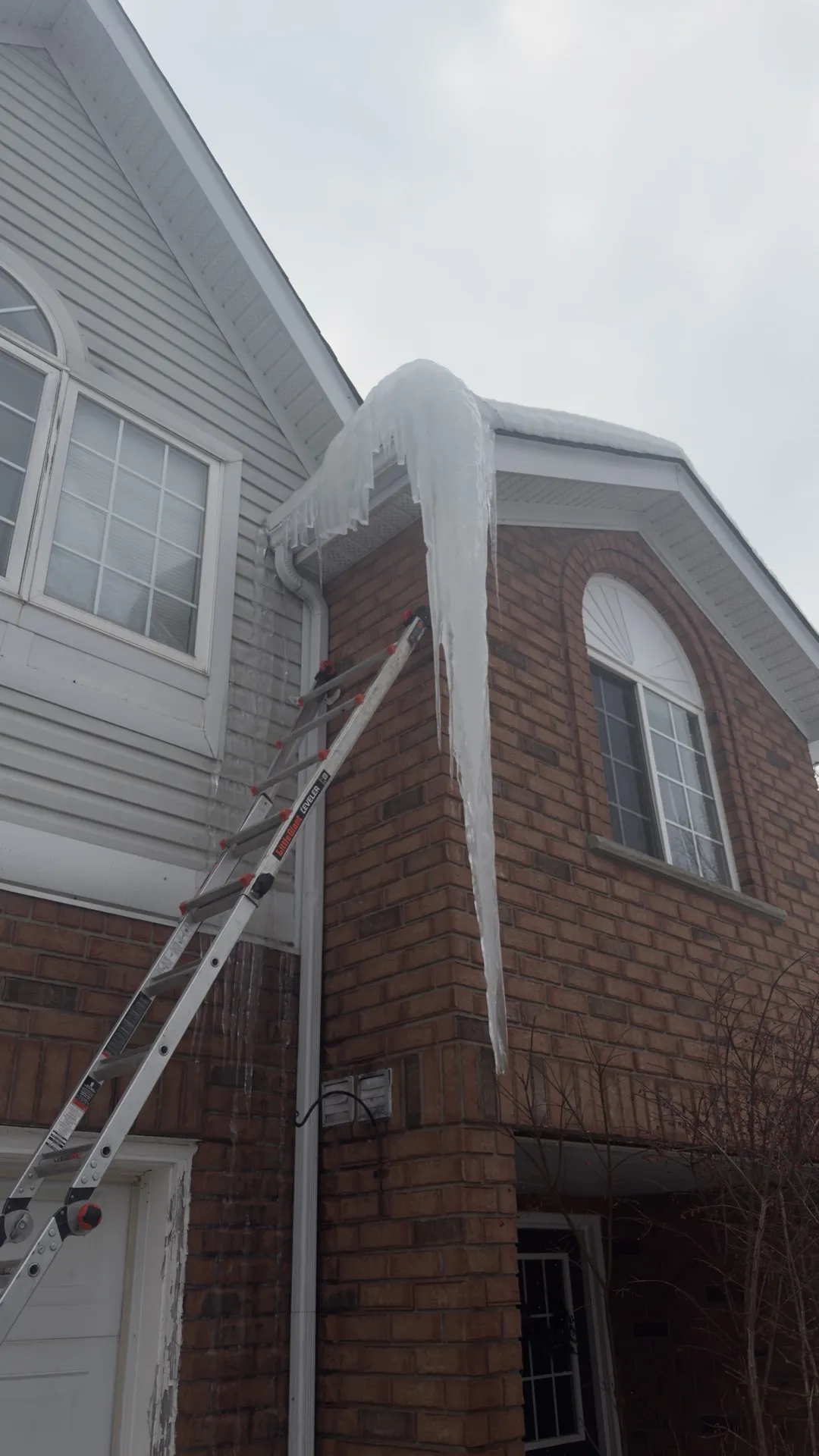
Condominium snow removal in Ontario is normally the corporation's job for the common elements, such as roads, parking and shared walkways, and owners clear only what the declaration assigns to them. The Condominium Act, 1998 makes the corporation maintain the common elements unless the declaration says otherwise, so read the declaration first. Liability and a contract checklist follow below.
In This Article
- Condominium snow removal: who clears what
- How the split changes by type of complex
- Residential snow removal in Kitchener-Waterloo for townhouse owners
- Who is liable when someone slips on ice in a condo?
- A seasonal contract checklist for boards and managers
- What drives the price of a condo snow contract
- Condo snow removal questions in Ontario
Condominium snow removal: who clears what
The Condominium Act, 1998 sets the default. Section 90 says the corporation maintains the common elements and each owner maintains the owner's unit. The Act defines common elements as all the property except the units, so roads, parking areas, shared walkways, entrances and stairs fall to the corporation unless something else is written down.
That something else is the declaration. Section 91 lets it shift duties, for example by making owners maintain the common elements, or the parts of them that only they use. Common examples are a private driveway, a patio or a balcony. If an owner fails to do a duty the declaration gives them, section 92 lets the corporation step in and do the work.
So the order of documents is simple. Read the declaration, then the by-laws and rules, then any contract the corporation has with a snow contractor. If they disagree with what a neighbour told you, the documents win.
Want an exact price for your home?
Skip the guesswork: we look at your actual property and quote it in writing, free and no-obligation. Serving Kitchener, Waterloo, Cambridge & Guelph.
How the split changes by type of complex
Not every complex is built the same way, and "who clears what" depends on which kind you live in.
| Type of complex | Corporation usually clears | Owner usually clears |
|---|---|---|
| Standard condominium (units inside shared buildings or stacked townhouses) | Roads, parking, walkways, entrances, ramps, stairs | Anything the declaration gives to the owner, such as an exclusive-use patio |
| Common elements condominium (freehold townhouses on their own lots, sharing roads and paths) | Shared roads, visitor parking, shared walkways | Own driveway and front walk, unless the by-laws or an agreement assign them to the corporation |
| Vacant land condominium | Common elements (section 162) | Own unit |
| Neighbourhood "HOA" or residents' group | Whatever the shared-road agreement or membership contract says | Whatever those documents leave to the owner |
A common elements corporation is the kind created under section 138, where the declaration creates shared property but does not divide the land into units. Some townhouse developments are set up this way. "HOA" is mostly an American term. In Ontario it usually means a condominium corporation, or a voluntary group that runs a shared road, so the rules come from the paperwork, not from a statute with that name.
Residential snow removal in Kitchener-Waterloo for townhouse owners
If you own a townhouse, ask three questions before the first storm. Which parts of my property are common elements? Does my fee already pay for clearing them? May I hire my own contractor for what is mine?
Check the public sidewalk as well. Kitchener's website says property owners must clear sidewalks around their property of snow and ice within 24 hours of a snowfall, to a bare pavement standard. Waterloo's by-law requires every owner to remove accumulations from the sidewalk next to the property within 24 hours. In a complex, the owner of the land next to the sidewalk is often the corporation, but confirm that with your manager. Other municipalities set their own rules, so check the by-law for yours.
Owners who are allowed to arrange their own clearing can look at snow removal from D&D Home Services, which starts from $80 per visit for typical Kitchener-Waterloo homes, with seasonal contracts available. Get the scope in writing, and make sure it does not clash with the corporation's contractor on a shared driveway. For how contracts are built, see the snow removal contract guide.
Who is liable when someone slips on ice in a condo?
This is general information, not legal advice. Your corporation's lawyer and insurer are the right people to ask about a specific case.
Ontario's Occupiers' Liability Act puts a duty on an occupier to take reasonable care that people on the premises are reasonably safe. An occupier includes someone with responsibility for and control over the condition of the premises, and there can be more than one occupier. A corporation that controls the common elements usually fits. An owner who controls their own driveway can fit too.
- Hiring a contractor helps, with conditions. Section 6 says an occupier is not liable for an independent contractor's negligence if it acted reasonably in hiring, took reasonable steps to check the contractor was competent and the work was done properly, and the work was reasonable to do. The Act also keeps duties that are non-delegable at common law.
- The 60-day notice. Under section 6.1, no one can sue for injury caused by snow or ice unless written notice of the claim, with date, time and place, is served or sent by registered mail within 60 days to an occupier or the snow contractor. Whoever receives it must pass a copy to the other occupiers and the contractor.
- Directors have their own standard. Section 37 of the Condominium Act asks directors to act honestly and in good faith, and with the care, diligence and skill of a reasonably prudent person.
In practice, this means three habits: forward any claim letter to the manager and insurer the same day, keep dated service records and weather notes, and act on resident complaints in writing. Records show what was done and when. They cannot prove what they do not contain.
A seasonal contract checklist for boards and managers
A good contract removes arguments before they start. Use this list when you compare bids, and add the answers to the contract itself.
- A scope map. Mark every road, lot, walkway, ramp, stair and bin pad as in or out, and name any area that is owner-cleared.
- Trigger. State the snow depth in centimetres that starts a visit, and what happens in freezing rain or drifting.
- Finish time. Ask for a completion standard, such as walkways clear by a stated hour on weekdays, instead of vague promises.
- Ice control. Say which product is used, who decides when to apply it, and whether return visits are included after refreezing.
- Piling and hauling. Agree where snow is stacked, and keep piles off fire routes, hydrants, mailboxes, drains and sight lines.
- Damage. Spell out who repairs curbs, lawns and fixtures hit by equipment, and how claims are made.
- Insurance and workers. Ask for a certificate of liability insurance naming the corporation, and for proof of WSIB coverage if the contractor has employees.
- Service logs. Require a record of each visit with date, times, work done and conditions on arrival.
- Dates and exit. Set the season start and end, a late-storm rule, and how either side can end the agreement.
- Contact. Get a number that reaches a person during storms.
The same points apply to commercial lots, covered in our commercial snow removal guide. Sign before the first lasting snow, since contractors often fill their routes as the season nears.
What drives the price of a condo snow contract
There is no single price for a complex, because no two sites are alike. Quotes usually turn on these factors:
- The paved area to plow and the total length of walkway to shovel or blow.
- Access and layout, such as tight courts, dead ends and many stairs.
- The trigger depth and the finish time you ask for.
- How much ice control is included, and whether visits after storms are billed.
- Whether snow can be piled on site or must be hauled away.
- The pricing model: per visit, a seasonal flat fee, or a hybrid with a cap.
Compare bids on the same scope map and the same trigger. A low price that leaves out the walkways, or only plows after 15 cm, is a different product from a higher bid that covers them. Ask each bidder to walk the site, since a written quote based on photos misses things.
Condo snow removal questions in Ontario
Who is responsible for snow removal in a condo?
By default, the condominium corporation maintains the common elements, including roads, parking and shared walkways, and owners maintain their units. The declaration can change this, for instance by making owners clear a private driveway or patio. Check the declaration, by-laws and any contractor agreement for the exact split in your complex.
Is a condo corporation liable if I slip on ice?
It can be. Ontario's Occupiers' Liability Act asks an occupier to take reasonable care, and a corporation that controls the common elements is usually an occupier. Whether it is liable depends on the facts, such as how long the ice was there and what was done. Speak with a lawyer about a specific injury.
Does an HOA handle snow removal in Ontario?
HOA is not a legal structure in Ontario. Most complexes are condominium corporations, and some neighbourhoods have a residents' group that runs a shared road. The agreement or declaration that created the group decides whether it clears snow, and which parts, so ask your manager or board for the document.
Do I have to shovel the public sidewalk in front of my condo townhouse?
It depends on who owns the land beside the sidewalk. Kitchener and Waterloo both require owners to clear the sidewalk next to their property within 24 hours. In many complexes the corporation is that owner, but a townhouse on its own lot may be yours. Confirm with your manager and the municipal by-law.
How long does someone have to give notice after a fall on snow or ice?
Under section 6.1 of Ontario's Occupiers' Liability Act, written notice of the claim must be served or sent by registered mail within 60 days of the injury, to an occupier or the snow contractor. Courts can excuse a late notice in some cases. An injured person should get legal advice quickly.
Key Takeaways
- The corporation maintains the common elements by default, and the declaration can assign parts to owners.
- Check the type of complex: standard, common elements, vacant land or a neighbourhood group.
- Kitchener and Waterloo require public sidewalks to be cleared within 24 hours by the property owner.
- Under Ontario law, a snow or ice injury claim needs written notice within 60 days.
- Put scope, trigger depth, finish time, ice control, insurance and logs in the contract.
Sources & References

Request a home-service quote
Select the service you need and describe the work area and access.