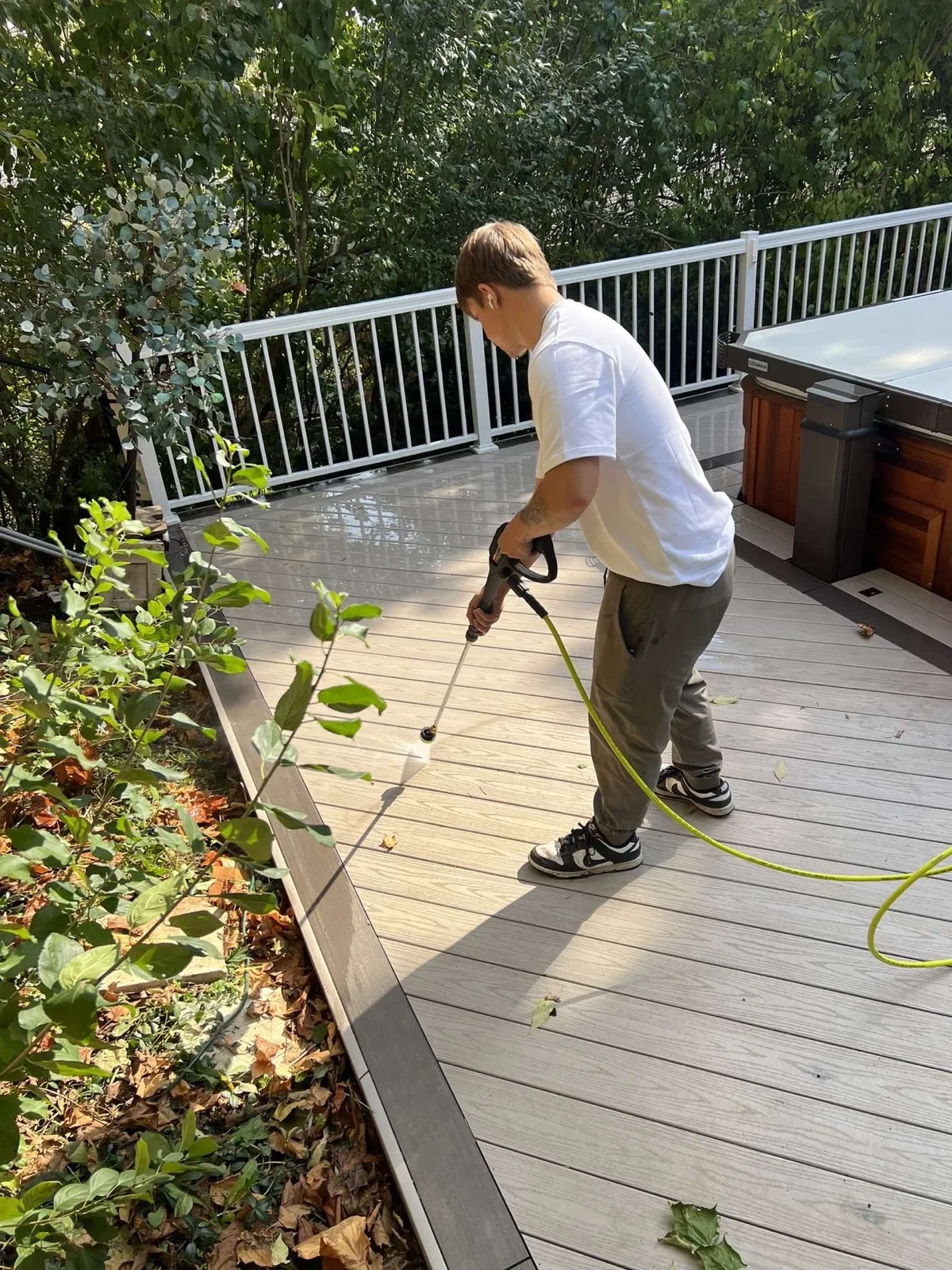
There's something satisfying about taking care of your own home. DIY exterior cleaning feels productive and saves money, in theory. But the reality for many Ontario homeowners is that DIY exterior cleaning carries real and underappreciated risks: injury, surface damage, insurance complications, and results that are significantly worse than what a professional produces. Here's an honest assessment of the risks, and guidance on when DIY is reasonable and when it isn't.
In This Article
- Ladder Fall Statistics: The Risk Most Homeowners Underestimate
- Pressure Washing Damage Risks: The Wrong PSI Destroys Surfaces
- Chemical Handling Risks
- Insurance Implications: DIY Exterior Work May Not Be Covered
- Time and Equipment Costs: The Math Most DIYers Get Wrong
- When DIY Makes Sense
- When to Hire Professionals: The Clear Cases
Ladder Fall Statistics: The Risk Most Homeowners Underestimate
Falls from ladders are consistently among the leading causes of serious injury and injury-related death in Canada. According to public health data, ladder falls account for tens of thousands of emergency room visits annually in Canada, with a disproportionate number occurring during home maintenance activities rather than professional work.
Why are home maintenance ladder falls so common? Several factors combine to create elevated risk for homeowners compared to trained workers:
- Infrequent use: Professional workers use ladders daily and develop automatic safety habits. Homeowners who use a ladder a few times a year don't have this muscle memory, and often underestimate the physical demands of ladder-based work.
- Equipment quality: Professional crews use rated commercial ladders with appropriate standoffs, stabilizers, and non-slip feet. Many homeowners use consumer ladders that are not appropriate for the height or angle of work required.
- Distraction: Professionals are focused entirely on safe work positioning. Homeowners are simultaneously thinking about the task, moving a hose, repositioning a squeegee, handling gutter debris, and their footing, making falls more likely.
- Overreach: The most common cause of ladder falls is reaching too far to the side rather than repositioning the ladder. Professionals reposition constantly; homeowners stretch to avoid the hassle.
- Wet surfaces: Gutter cleaning and window washing involve water, which makes ladders, rungs, rooflines, and footing slippery. Professionals are trained to account for this and use dry footwear and equipment; homeowners often don't.
On a two-storey Ontario home, the eaves are approximately 5-6 metres from the ground. A fall from this height is potentially fatal and will almost certainly result in serious injury. This risk doesn't go away regardless of how careful you are, it's a probability that increases with every task you perform at that height.
Pro Tip: If your home has two storeys or more, the risk-benefit calculation for DIY ladder work almost always favours hiring a professional. The cost of gutter cleaning or window cleaning is a fraction of the cost, financial and otherwise, of a ladder fall. This isn't fearmongering; it's straightforward risk math.
Pressure Washing Damage Risks: The Wrong PSI Destroys Surfaces
Pressure washers are among the most commonly misused pieces of home maintenance equipment. The assumption that "more pressure equals more clean" leads homeowners to apply pressures far beyond what various surfaces can safely handle, with results that range from disappointing to seriously damaging.
Surface damage from excessive pressure:
- Vinyl siding: Too much pressure drives water behind the siding, past the weep holes and j-channels that are designed to allow controlled drainage, and into the wall cavity. The result is wet insulation, potential mold, and moisture damage to the structural components behind the siding. Additionally, high pressure at incorrect angles can bend or crack vinyl panels permanently.
- Wood surfaces: High pressure raises wood grain, leaving a rough, fuzzy surface that is worse to stain or paint than the surface before washing. It can also force water deeply into wood fiber, promoting conditions for rot if the wood doesn't dry fully before cold weather.
- Brick and mortar: Old mortar is vulnerable to high pressure. The softer lime-based mortars found in Ontario homes built before the 1970s can be deeply eroded or completely removed by a pressure washer held at close range. Once mortar is damaged this way, repointing is required, a costly masonry repair.
- Interlocking brick patios: High pressure removes the jointing sand between interlocking pavers, causing them to shift and become unstable. Replacing jointing sand requires renting a plate compactor and purchasing new polymeric sand, an avoidable hassle and expense.
- Roof shingles: Pressure washing asphalt shingles, ever, removes the protective granules that provide UV resistance and extend shingle life. A pressure-washed roof effectively has its lifespan shortened by years. Soft washing is the only appropriate method for roof cleaning.
Professional exterior cleaning services understand surface-specific requirements. Our soft washing service uses low pressure combined with appropriate cleaning solutions, effective against mold and algae without the surface damage that high pressure causes on vulnerable materials.
Need a hand with your home's exterior?
From gutters and windows to full exterior washes, we help homeowners across Kitchener, Waterloo, Cambridge & Guelph. Free, no-obligation quotes, ready within 1 business day.
Chemical Handling Risks
Effective exterior cleaning often involves cleaning solutions, bleach-based products for algae and mildew, acid-based products for concrete efflorescence, and other chemical treatments. These chemicals, improperly handled, create real risks.
Bleach and mold killers: Sodium hypochlorite (household bleach) is commonly used in DIY soft washing formulas. Concentrated bleach causes chemical burns to skin and eyes, and its fumes are hazardous in enclosed or low-wind conditions. Many DIYers don't wear appropriate PPE, chemical-resistant gloves, eye protection, and respiratory protection in confined areas, when working with concentrated bleach solutions.
Critically, bleach must never be mixed with ammonia-based cleaners (common in glass cleaners), acidic cleaners, or hydrogen peroxide. These combinations produce chlorine gas or other toxic byproducts. In a confined area, working in a window well, for example, even brief exposure to chlorine gas can cause serious respiratory injury.
Landscaping damage: Bleach run-off from house washing kills grass, plants, and garden beds if not properly managed. Professional soft washing crews direct runoff and rinse surrounding vegetation; DIY washers often don't anticipate where the runoff goes and cause unexpected plant death.
Concrete and masonry acid cleaners: Muriatic acid (hydrochloric acid) is sometimes used to remove efflorescence, rust stains, and mineral deposits from concrete and masonry. This is a dangerous chemical that requires full face protection, acid-resistant gloves, and careful dilution. Improper use causes chemical burns and can damage the surface being cleaned if applied at wrong concentration.
Insurance Implications: DIY Exterior Work May Not Be Covered
This is a risk that almost no DIY exterior cleaning article discusses, but it's genuinely important for Ontario homeowners.
Most standard home insurance policies cover sudden and accidental damage to your property. What many policies exclude, or apply exclusions to, is damage resulting from homeowner DIY work that falls outside the standard of care for the task. The specific language varies by insurer and policy.
The practical implications:
- If you pressure wash your vinyl siding and force water into the wall assembly, causing mold damage to the interior that appears months later, your insurance company may deny the claim on the basis that the damage resulted from improper maintenance rather than a covered peril.
- If you damage your roof by pressure washing shingles (removing granules), the resulting premature shingle failure may not be covered as it resulted from homeowner action rather than weather damage.
- If you fall from a ladder and your property is damaged in the fall, a tree limb breaks through a window, or your ladder leans against and damages the eavestrough, the damage claim may be handled differently than if it resulted from a weather event.
A licensed, insured professional, like D&D Home Services, carries commercial liability insurance that covers damage arising from our work. If our crew damages something in the course of providing service, you are protected. The same protection doesn't exist for DIY work.
Time and Equipment Costs: The Math Most DIYers Get Wrong
The calculation most homeowners make when considering DIY vs. professional is simple: professional cost vs. $0 (DIY). But this ignores the real costs of DIY exterior cleaning:
Equipment costs or rental:
- Consumer pressure washer purchase: $200-600 (often insufficient flow for effective cleaning anyway)
- Pressure washer rental: $60-100/day, plus transport and setup time
- Extension ladders appropriate for two-storey work: $200-500 to purchase, or ladder rental costs
- Appropriate nozzles, surface cleaners, hose extensions: $30-100
- Cleaning chemicals and PPE: $50-150
A homeowner renting or purchasing equipment for a single DIY gutter cleaning and pressure washing day can spend $200-400 before accounting for their time. A professional service completing the same work typically costs $300-600, similar cost, zero equipment hassle, professional result, and no personal risk.
Time cost: A professional crew with commercial equipment completes a full house soft wash in 2-3 hours. A DIY homeowner with a consumer pressure washer and rental equipment typically takes 6-10 hours for the same property, accounting for setup, tank refills, re-washing areas that didn't come clean, and cleanup. At any reasonable valuation of your time, professional cleaning is economically competitive.
Result quality: Commercial cleaning equipment operates at significantly higher flow rates (GPM) than consumer equipment. Higher flow, combined with professional technique and appropriate chemicals, produces results that consumer equipment simply cannot match, particularly on heavily soiled surfaces, long-established algae growth, and difficult-to-reach areas.
When DIY Makes Sense
This article is not arguing that all exterior home maintenance should be outsourced. There are tasks where DIY is reasonable, safe, and genuinely cost-effective:
- Ground-level caulking: Re-caulking accessible ground-floor window and door perimeters requires minimal equipment, carries no fall risk, and is straightforward to do correctly with basic instruction.
- Downspout extension installation: A simple, safe, ground-level task that requires no special equipment.
- Minor driveway crack filling: Accessible at ground level, low risk, achievable with affordable materials from any hardware store.
- Window washing (ground floor only): Ground-floor exterior windows can be safely cleaned by most homeowners with a squeegee and bucket. Professional results require technique and pure water equipment, but adequate results are achievable at ground level.
- Deck pressure washing (single storey): A garden hose and deck brush, or a low-PSI consumer pressure washer, can clean a ground-level deck without significant risk of damage if the nozzle distance is kept appropriate (12-18 inches minimum for wood).
When to Hire Professionals: The Clear Cases
There is a clear set of circumstances where hiring a professional exterior cleaning company is the right decision from safety, quality, and economic perspectives:
- Any work above one storey: Gutter cleaning, second-floor window washing, high siding washing. The ladder fall risk at this height is not worth the savings.
- Roof cleaning of any kind: Never appropriate as a DIY task, the fall risk is extreme and any pressure washing of shingles will damage them.
- Large homes or large areas: The time and equipment investment for extensive DIY cleaning quickly approaches the professional service cost while delivering inferior results.
- Mold or algae on siding or brick: Effective treatment requires soft washing with appropriate chemical concentrations, not achievable with consumer pressure washers and garden hose attachments.
- Pre-listing cleaning: The quality of the result matters too much for listing photos and buyer impressions to risk an inferior DIY outcome.
DIY vs. Professional, Key Takeaways
- ✓ Ladder falls are the most serious risk: For any work above one storey, professional service is the right choice, period. The savings don't justify the risk.
- ✓ Wrong pressure destroys surfaces: Vinyl siding, wood, old brick, and roofing shingles are all damaged by excessive pressure. Professionals know appropriate pressure for each surface.
- ✓ Real DIY costs are higher than homeowners expect: Equipment rental, supplies, and time often bring DIY costs close to professional pricing, with inferior results.
- ✓ DIY damage may not be insured: Damage from improper DIY maintenance may be excluded from your home insurance policy.
- ✓ DIY is reasonable at ground level: Caulking, crack filling, downspout extensions, and ground-floor window washing are appropriate DIY tasks. Everything above that, hire a pro.

Request a home-service quote
Select the service you need and describe the work area and access.