Birds on your roof and in your gutters aren't just an aesthetic nuisance, they cause real damage. Nesting material clogs drainage systems, acidic droppings degrade roofing materials, and bird activity attracts secondary pests like mites and insects into your home's exterior. Managing bird activity on your home requires understanding why birds choose specific spots and which deterrents actually work in Ontario.
In This Article
The most reliable way to keep birds out of gutters is a fine-mesh gutter guard, which closes off the trough birds use as a nesting cavity, typically $18–$30 per linear foot installed in Ontario as of 2026. For roof perching, add stainless bird spikes ($4–$8 per foot installed) along the ridge cap. Install everything before late March, when Kitchener-Waterloo sparrows begin choosing nest sites.
Here is how the main deterrent options compare on cost and effectiveness at typical 2026 Ontario market rates:
| Deterrent | Typical installed cost (Ontario, 2026) | Best for | Effectiveness |
|---|---|---|---|
| Micro-mesh gutter guards | $18–$30 / linear ft | Nesting inside gutters | Excellent, permanent physical barrier |
| Stainless bird spikes | $4–$8 / linear ft | Ridge & ledge perching | Very good on covered surfaces |
| Exclusion netting | $6–$12 / sq ft | Eaves, balconies, entry gaps | Very good when professionally tensioned |
| Soffit / fascia gap sealing | $150–$500 per home | Attic entry points | Excellent, stops the costliest damage |
| Owl decoys / reflective tape | $15–$60 DIY | Short-term relief only | Poor, birds habituate within days |
Why Birds Target Gutters and Roofs
Gutters appeal to birds, particularly house sparrows and European starlings, the two most common problem species in Kitchener-Waterloo, for straightforward reasons: they're warm, sheltered, elevated, and often full of organic material that makes excellent nesting substrate. The gutter trough is essentially a ready-made nest cavity with built-in weather protection from the roof overhang above and the fascia behind.
House sparrows in particular are year-round residents of Ontario that begin scouting nesting sites as early as February. They're cavity nesters by nature, they evolved nesting in rock crevices and hollow tree cavities, and modern residential architecture offers abundant human-made equivalent sites: gutters, downspout openings, gaps in soffits, and vents. Once a pair establishes a nest site, they return to it year after year and aggressively defend it against other birds.
Roof ridges and peaks attract perching birds (pigeons, crows, starlings, and seagulls increasingly moving inland) because elevation provides a wide field of vision for spotting predators and food sources. Roof surfaces collect and retain heat, dark shingles in direct sun can reach 60°C to 70°C, making them comfortable perching spots in cooler weather. The south-facing slopes of roofs in Ontario's climate are particularly favoured.
Damage Birds Cause
Nesting material in gutters is the most immediately problematic consequence of bird activity. A pair of house sparrows can fill a 10-foot gutter section with dried grass, feathers, and debris within a week during active nest-building in spring. This material absorbs and holds moisture, compacts over the season, and blocks drainage more effectively than leaf debris because of its fine, interlocking texture. Unlike leaves that partially decompose and shift in water flow, bird nest material forms a near-solid plug.
The larger volume problem is bird droppings. A single starling produces approximately 10 kilograms of droppings per year. A colony of roof-perching birds deposits this material consistently on roofing, siding, windows, and hardscape. Bird droppings have a pH of around 3 to 4.5, strongly acidic, and are well-documented to accelerate degradation of roofing materials. Asphalt shingles, which rely on a granule coating for UV and weather protection, are particularly vulnerable. Droppings soften the asphalt binder, dislodge granules, and accelerate the aging that leads to shingle failure.
On windows and siding, droppings that dry and then rewet repeatedly create staining that is difficult to remove without abrasive cleaning. Our soft washing service can remove accumulated bird dropping deposits from siding safely, but prevention is far preferable to remediation.
The Kitchener-Waterloo climate makes blocked gutters especially costly. Our region cycles through dozens of freeze-thaw events each winter, and a gutter plugged with compacted nest material holds meltwater that refreezes overnight, the classic recipe for ice damming, split seams, and fascia rot. Homes in mature-tree neighbourhoods such as Westmount, uptown Waterloo, and older Cambridge streets see the worst of it, because heavy leaf load and bird nesting compound each other in the same trough.
Need a hand with your home's exterior?
From gutters and windows to full exterior washes, we help homeowners across Kitchener, Waterloo, Cambridge & Guelph. Free, no-obligation quotes, ready within 1 business day.
Humane Deterrent Methods
Bird deterrence is most effective when applied proactively, before birds establish nesting sites, rather than reactively after nesting has begun. The most effective deterrents physically prevent access or create an uncomfortable surface; sensory deterrents (noise makers, visual scare devices) have limited long-term effectiveness because birds habituate to them quickly.
Bird spikes are metal or plastic strips with rows of upward-pointing prongs that prevent perching on flat surfaces like ridge caps, ledges, and flat roof edges. They are effective on ridges and other specific perching locations where birds consistently land in the same spot. Properly installed spikes do not harm birds, they simply make the surface uncomfortable to land on, redirecting birds to other locations. Galvanized steel spikes hold up well through Ontario winters; cheap plastic versions become brittle and fail within two to three seasons.
Reflective tape and visual deterrents (predator silhouettes, owl decoys) have limited effectiveness as standalone measures. Birds in urban environments quickly learn that these static objects pose no real threat and ignore them within a few days of installation. They may provide temporary relief during the first days of deployment but should not be relied on as primary deterrents. If used at all, they work slightly better when moved to different locations regularly to prevent habituation.
Mesh netting can exclude birds from specific areas, under eaves, over balconies, or across gaps in architectural features where birds enter to nest. Installation requires careful tensioning and secure edge attachment; improperly installed netting can entangle and injure birds, which creates both an ethical and a legal problem under federal wildlife legislation.
Gutter Guards as Bird Deterrents
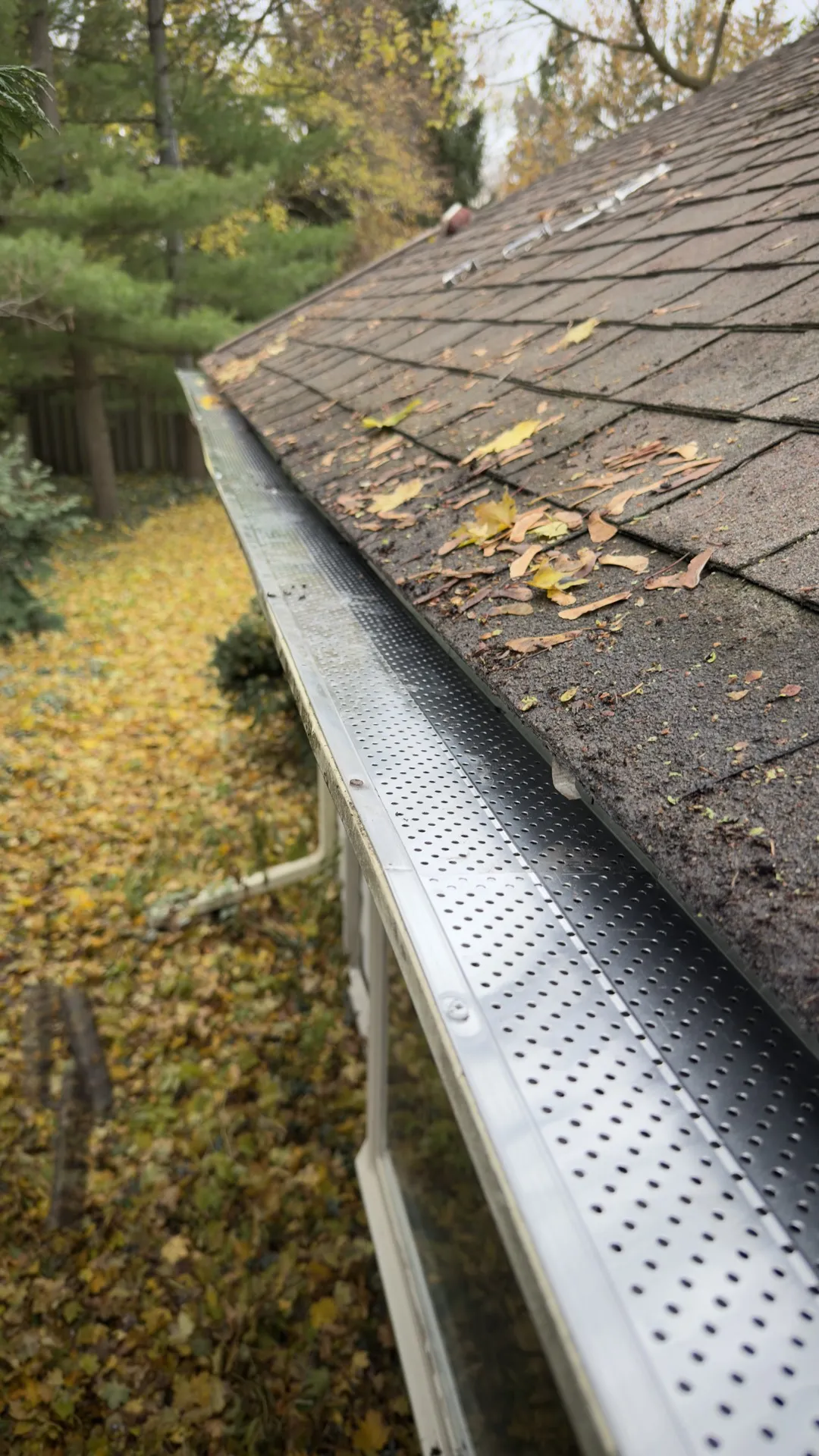
From a practical standpoint, gutter guards are among the most effective tools for preventing gutter nesting. A well-fitted gutter guard, particularly fine-mesh or micro-mesh designs, closes off the open gutter trough entirely, making it physically impossible for birds to deposit nesting material inside the gutter or access the interior as a nesting cavity.
Our gutter guard service installs premium guard systems that provide a continuous physical barrier across the gutter opening. Beyond the primary benefit of debris exclusion, this physical closure eliminates the accessible cavity that makes gutters attractive to nesting birds. Homes that have installed quality gutter guards consistently report a significant reduction in bird nesting problems specifically in the gutter zone.
The gutter guard doesn't address roof ridge perching or other elevated surface issues, but it does resolve the nesting-in-gutters problem definitively, which is typically the most damaging form of bird activity in terms of drainage impact and property damage.
Pro Tip: The optimal window to install bird deterrents and gutter guards is late winter, February through mid-March in the Kitchener-Waterloo area, before house sparrows begin serious nest site selection in late March and April. Installing deterrents after sparrows have already selected a site is significantly harder because they are strongly motivated to return to a chosen location.
Roof Bird Control
For persistent perching problems on roof ridges, the most effective solution is bird spikes installed along the ridge cap. This requires working at height and careful placement to cover the full ridge length where birds are landing. Professional wildlife control companies can install these with appropriate safety equipment and ensure coverage is complete, partial coverage simply moves birds to the uncovered sections of the ridge.
Electric deterrent systems (low-voltage electric tracks that deliver a mild shock when birds land) are used on commercial buildings and are occasionally appropriate for severe residential problems. They require professional installation and electrical permits, and are typically overkill for standard residential bird issues.
Physical exclusion of potential entry points into the attic, gaps around fascia boards, open soffit sections, and uncapped chimney tops, is one of the most important long-term roof bird management measures. Birds that enter attic spaces cause far more damage than those perching on the exterior. Annual inspection of the roofline and soffit perimeter, combined with prompt repair of any openings, prevents most attic bird intrusions.
Ontario Migratory Bird Protections
Before taking any bird management action on your property, it's important to understand the legal framework. The federal Migratory Birds Convention Act (MBCA) protects nearly all wild bird species in Canada, including house sparrows, starlings, and virtually every other species you're likely to encounter on your roof or in your gutters. The key legal provisions are:
You cannot disturb, destroy, or move an active nest containing eggs or young birds. An active nest is one with eggs or hatchlings present, not just nesting material. This means that once a pair of sparrows or starlings has laid eggs in your gutter, you must wait until the young have fledged (typically four to six weeks for most species) before the nest can be removed. Removing an active nest with eggs or young is a federal offence.
The legal window for removing nesting material from gutters and blocking access points is before nest construction begins (late winter, before April) or after the season when nesting has concluded and young have fledged (typically late summer). The nesting season for most Ontario songbirds runs from approximately April through July, with second broods sometimes extending into August. Conducting your gutter cleaning and deterrent installation outside this window avoids the active nest problem entirely.
House sparrows and European starlings, both non-native invasive species introduced to North America in the 1800s, are actually exempt from many of the strongest MBCA protections in practice, but the regulations are complex and enforcement interpretations vary. The safest approach for homeowners is to work outside the April-to-August nesting season and focus on deterrence rather than active nest interference.
Frequently Asked Questions
What is the best way to keep birds out of gutters?
A fine-mesh or micro-mesh gutter guard is the most effective solution. It physically closes off the open gutter trough that sparrows and starlings use as a nesting cavity, so birds cannot deposit nesting material inside. In Ontario, professionally installed micro-mesh guards typically run $18–$30 per linear foot as of 2026.
Is it illegal to remove a bird nest from my gutters in Ontario?
It is illegal to disturb or remove an active nest, one containing eggs or young birds, under the federal Migratory Birds Convention Act. Once eggs are laid you must wait until the young fledge, typically four to six weeks. Empty nests and loose nesting material can be removed outside the April-to-August nesting season.
When should I install bird deterrents in Kitchener-Waterloo?
February through mid-March is the optimal window. House sparrows in the Kitchener-Waterloo area begin serious nest-site selection in late March, and deterrents installed before then are far more effective than trying to displace birds after they have chosen a site.
Do fake owls and reflective tape actually keep birds away?
Not for long. Urban birds habituate to static visual deterrents within days once they learn the objects pose no threat. Physical barriers, gutter guards, bird spikes, and mesh netting, consistently outperform decoys and tape, which at best provide a few days of temporary relief.
How much does bird-proofing a house cost in Ontario?
As of 2026, typical Ontario ranges are $4–$8 per linear foot for professionally installed stainless bird spikes, $18–$30 per linear foot for micro-mesh gutter guards, $6–$12 per square foot for exclusion netting, and roughly $150–$500 to seal soffit and fascia gaps. Most homes need only one or two of these measures.
What damage do birds actually cause to gutters and roofs?
Nesting material forms near-solid plugs that block drainage and cause overflow, fascia rot, and winter ice damming. Bird droppings are acidic (pH 3–4.5) and accelerate asphalt shingle degradation, a single starling produces about 10 kg of droppings per year. Droppings also stain siding and windows.
Do gutter guards stop birds from nesting?
Yes, for the gutter trough itself. A well-fitted micro-mesh guard removes the sheltered cavity birds nest in, and homes with quality guards report a significant drop in gutter nesting. Guards do not stop ridge perching, so persistent roof problems may also need bird spikes along the ridge cap.
Which birds cause the most problems on Kitchener-Waterloo homes?
House sparrows and European starlings are the two most common problem species, both are cavity nesters that treat open gutters, downspout openings, and soffit gaps as ready-made nest sites. Pigeons, crows, and gulls are the usual ridge-perching culprits, especially on south-facing slopes.
Key Takeaways
- ✓ Act before spring: Install deterrents in February or March before sparrows begin nest site selection, reactive deterrence after nesting begins is far harder.
- ✓ Gutter guards work: Fine-mesh gutter guards physically close off the open gutter trough that birds use as a nesting cavity, the most effective gutter-specific deterrent.
- ✓ Droppings cause real damage: Acidic bird droppings accelerate shingle degradation and create staining on siding and windows that requires professional cleaning.
- ✓ Spikes beat scare devices: Physical deterrents (bird spikes on ridges) are consistently more effective than visual or auditory scare methods, which birds habituate to quickly.
- ✓ Know the law: Active nests with eggs or young birds cannot be disturbed under the federal Migratory Birds Convention Act, work in late winter or late summer to avoid this complication.

Request a home-service quote
Select the service you need and describe the work area and access.