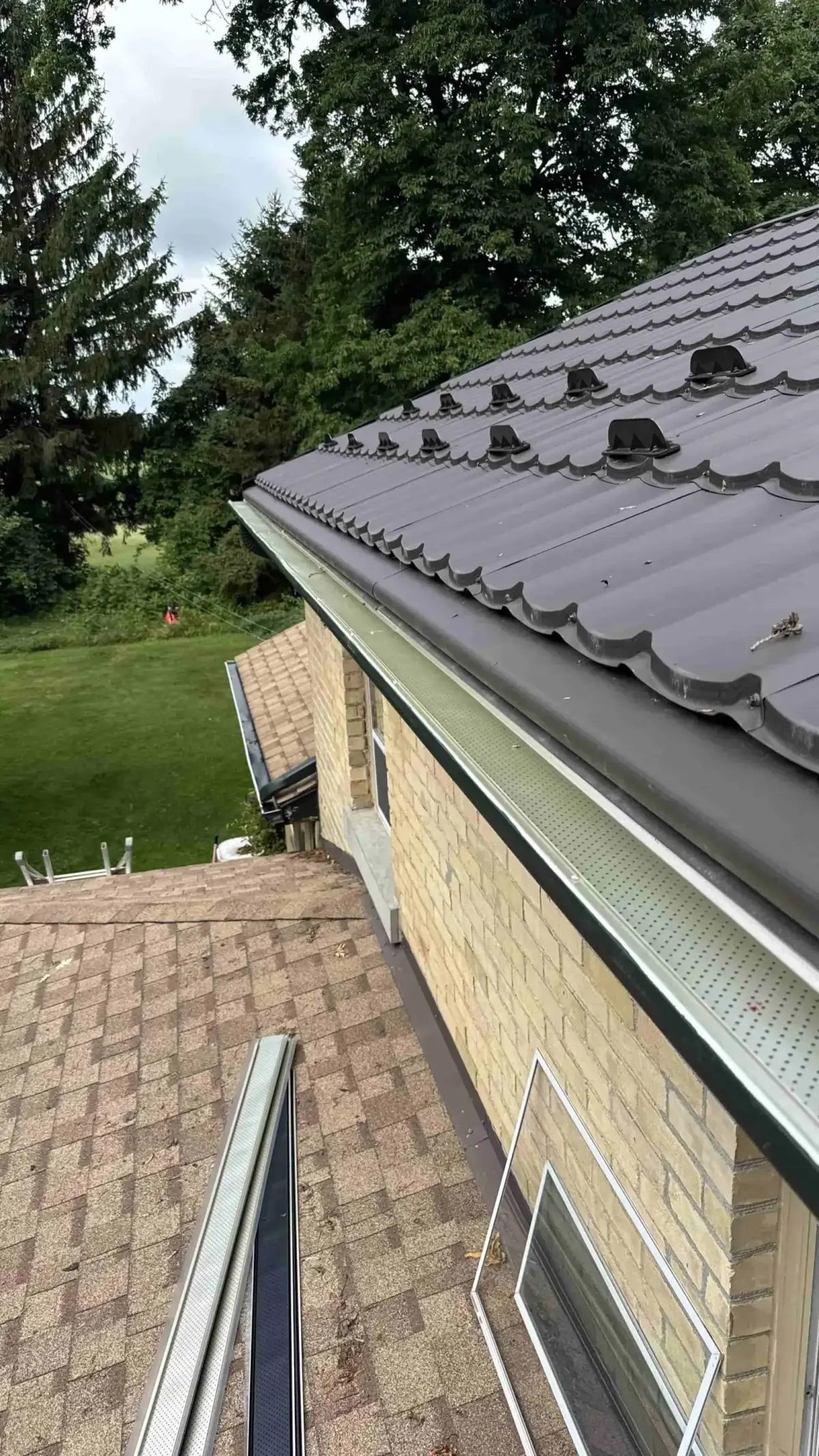
When it's time to replace or install gutters on your Kitchener-Waterloo home, the material choice matters as much as the style. Ontario's climate, with temperatures swinging from -25°C in January to 35°C in August and dozens of freeze-thaw cycles in between, is one of the most demanding environments for gutter materials in Canada. Here's a clear-eyed look at how each material performs in our specific conditions.
In This Article
Aluminum Gutters
Aluminum is the dominant gutter material in Ontario, and for good reason. It strikes the best balance of cost, durability, performance, and workability for our climate. Aluminum doesn't rust, a critical advantage in a province where road salt is everywhere from November through April and moisture exposure is nearly year-round. The surface oxidizes naturally to form a protective layer that actually resists further corrosion rather than accelerating it the way steel rust does.
Aluminum's thermal expansion characteristics are manageable. In extreme temperature swings, aluminum gutters expand and contract, but the amount is small enough that properly hung systems accommodate this movement without joint failure. At typical Ontario winter temperatures, even during the cold snaps that bring -20°C to -25°C to the Kitchener area, aluminum remains ductile and flexible rather than becoming brittle.
Aluminum gutters can be painted any colour to match your home's trim. Factory baked-on finishes on quality aluminum gutters hold colour well for 15 to 20 years before fading or chalking becomes noticeable. The material is light enough to handle easily during installation but rigid enough to hold its profile under ice loading when properly gauged. We recommend .027-inch gauge (thicker than the standard .019-inch) for Ontario installations, the thicker profile handles ice weight better and dents less easily from ladder contact during maintenance.
Vinyl Gutters
Vinyl gutters are attractive for one primary reason: they are cheap. A sectional vinyl gutter system costs less than any other material, making it tempting for budget-conscious homeowners and for builders trying to minimize per-unit construction costs. This is why vinyl gutters appear on a significant percentage of Ontario subdivision homes built between 1990 and 2015.
The fundamental problem with vinyl in Ontario is cold-temperature brittleness. Polyvinyl chloride (PVC), the material vinyl gutters are made from, becomes increasingly brittle as temperatures drop below freezing, and significantly more brittle at the extreme cold temperatures that Kitchener-Waterloo regularly experiences. At -20°C, vinyl gutters can crack from impact (a falling branch, a falling icicle, even aggressive cleaning with a stiff brush) in ways that aluminum gutters would simply dent.
This brittleness compounds with UV degradation over time. After five to ten years of Ontario sun, vinyl gutters become chalky and develop micro-cracks throughout the material. The surface becomes porous, holds moisture and algae more readily, and becomes even more susceptible to cold cracking. By the time a vinyl gutter system is fifteen years old on an Ontario home, it is typically showing significant degradation.
Vinyl gutters are also difficult to repair when they crack, unlike aluminum, which can be patched with sealant, cracked vinyl typically requires section replacement. And vinyl cannot be painted when it fades, which means a faded system looks bad permanently unless the entire gutter is replaced. For Ontario homes, vinyl is a short-term economical choice that becomes an expensive problem within a decade or two.
Tired of cleaning gutters twice a year?
We install premium gutter guards on homes across Kitchener, Waterloo, Cambridge & Guelph. Free, no-obligation quotes, ready within 1 business day.
Copper Gutters
Copper is the prestige gutter material, beautiful, extremely durable, and priced accordingly. A copper gutter system installed on an Ontario home will likely still be functioning fifty or more years from installation, developing a distinctive green patina over the first decade that many homeowners find architecturally appealing. It is the only gutter material where age genuinely improves appearance.
Copper handles freeze-thaw cycles exceptionally well. It remains ductile in extreme cold, has natural antimicrobial properties that resist algae and mould growth inside the gutter, and never rusts. The material is heavier than aluminum, which means it holds its position well even under significant ice loading, but also requires more robust hanger systems.
The single defining limitation of copper is cost. Copper gutters in Ontario typically cost $25 to $40 per linear foot installed, four to six times the cost of a quality seamless aluminum installation. On a 150-foot home, that's a total investment of $3,750 to $6,000 versus $900 to $1,500 for aluminum. The payoff is a 50-plus year system that genuinely adds to a home's character and value, but the upfront cost puts copper firmly in the luxury category for most homeowners.
Copper requires compatible metal components throughout, copper or stainless steel hangers, screws, and downspouts. Dissimilar metals in contact with copper cause galvanic corrosion that damages both the copper and the contacting metal. This adds to the installation complexity and cost.
Freeze-Thaw Performance
Ontario's freeze-thaw cycles are the definitive material test for gutters. The Kitchener-Waterloo region typically experiences 50 to 80 freeze-thaw cycles per winter, each cycle stresses joints, hangers, and the gutter material itself. After ten to fifteen winters, the cumulative effect on different materials is dramatic.
Aluminum shows minimal degradation from freeze-thaw cycling. The material itself handles thermal cycling without fatigue. The vulnerable points, joints in sectional systems, hanger fasteners, and end caps, degrade over time, but the aluminum body of the gutter remains sound. Aluminum's lifespan in Ontario is 20 to 30 years with proper maintenance.
Vinyl shows significant degradation from repeated freeze-thaw cycling. Each cycle exacerbates the existing brittleness, and the joints between sectional vinyl pieces are particularly vulnerable because thermal expansion and contraction in vinyl is significantly greater than in metals, pushing joints open more aggressively. Vinyl's realistic lifespan in Ontario conditions is 10 to 15 years before degradation becomes problematic.
Copper is essentially unaffected by freeze-thaw cycling in the material itself. The solder joints used in premium copper gutter installations are more durable than the sealant joints used in aluminum systems. Copper's lifespan in Ontario, with proper installation, is effectively measured in generations rather than decades.
| Material | Cost (installed) | Ontario Lifespan | Freeze-Thaw Performance | Can Be Painted |
|---|---|---|---|---|
| Aluminum (seamless) | $6–10/ft | 20–30 years | Excellent | Yes |
| Aluminum (sectional) | $5–8/ft | 15–20 years | Good (joints fail) | Yes |
| Vinyl | $3–6/ft | 10–15 years | Poor (brittle at -20°C) | No |
| Copper | $25–40/ft | 50+ years | Excellent | N/A (patinas) |
Our Recommendation for KW Region
For the vast majority of homeowners in Kitchener, Waterloo, Cambridge, and Guelph, seamless aluminum gutters are the clear recommendation. They perform reliably in Ontario's climate, cost a fraction of copper, last two to three times longer than vinyl, and require minimal maintenance beyond regular cleaning. The material's versatility, available in dozens of colours, capable of being painted, fabricatable in both K-style and half-round profiles, means it suits any home from a new subdivision build to a Victorian heritage home.
If you have a heritage home or a custom home where budget is not the primary concern, copper gutters are a genuinely excellent investment. The 50-plus year lifespan means you may never need to replace them during your ownership, and the aesthetic payoff of a mature copper patina is distinctive and beautiful.
Vinyl is one we actively steer customers away from for whole-home installations. If vinyl is already installed and in good shape, clean and maintain it, but when it comes time to replace, the modest savings versus aluminum don't justify the reduced lifespan and cold-weather brittleness. Our eavestrough installation service uses aluminum exclusively, and we're happy to discuss why when you contact us for a quote.
Key Takeaways
- ✓ Best choice for most homes: Seamless aluminum, durable, rust-proof, paintable, handles freeze-thaw well, and reasonably priced.
- ✓ Avoid vinyl in Ontario: PVC becomes brittle at -20°C, degrades with UV, and can't be painted, a short-term saving with long-term costs.
- ✓ Copper is excellent but expensive: $25–40/ft installed is justified for premium homes where a 50+ year, maintenance-minimal system is the goal.
- ✓ Gauge matters for aluminum: Specify .027-inch gauge for Ontario installations, the heavier gauge handles ice loading and impact better.
- ✓ Freeze-thaw is the test: Ontario's 50–80 annual freeze-thaw cycles will expose any weakness in material or installation within a few years.
Sources & References
- The Aluminum Association - Aluminum Alloy Temper Designation System (3105 alloy specifications)
- Environment and Climate Change Canada - Canadian Climate Normals 1991–2020 (freeze-thaw cycle frequency, Waterloo region)
- Canadian Home Builders' Association (CHBA) - Builder's Manual: Rainwater Management (eavestrough sizing standards)
- Vinyl Institute - uPVC Performance Data at Low Temperatures (PVC brittleness at −20°C)

Request a home-service quote
Select the service you need and describe the work area and access.